
Since 2006
Welcome to CHINA SINOTRUCK HK LIMITED !










Title: Essential Tips to Protect Your Trailer Axles From Rain & Flood Damage
Introduction
Heavy seasonal rainfall, flash floods and waterlogged road surfaces are common challenges for haulage fleets across all continents each year. Standing rainwater and deep puddles can severely damage trailer wheel hubs, bearings and braking systems, leading to sudden breakdowns, costly component replacements and even dangerous road accidents.
To safeguard your semi-trailers and guarantee consistent safe hauling performance, we’ve compiled this universal guide covering preventive driving habits and post-flood inspection & maintenance procedures for all trailer models.
Critical Driving Guidelines to Avoid Water Immersion Damage
1.Route planning & driving limits
Avoid traveling through low-lying areas, muddy depressions or road puddles where water depth exceeds half the height of your tires. Deep submergence lets water seep past hub seals, contaminating internal grease and corroding core axle parts.
2.Proper parking standards during rainy weather
When stopping overnight or for long breaks in wet conditions, park your trailers on elevated, well-drained ground. Flat, low ground with poor drainage will trap rainwater around wheel assemblies, triggering long-term water infiltration even when the vehicle is stationary.
Mandatory Inspection & Maintenance After Water Submersion
If your trailer has traveled through deep water (water level over half tire height) or stayed submerged for an extended period, complete these two core checks immediately before returning to operation:
1. Wheel Hub & Bearing System Inspection
Remove the hub cap to examine internal grease and seals for water intrusion.
Normal hub assembly: Fresh, clean waterproof grease fully coats bearings with no moisture or rust buildup.
Water-damaged hub assembly: Diluted, discolored grease, rusted bearing surfaces and moisture residue inside the housing.
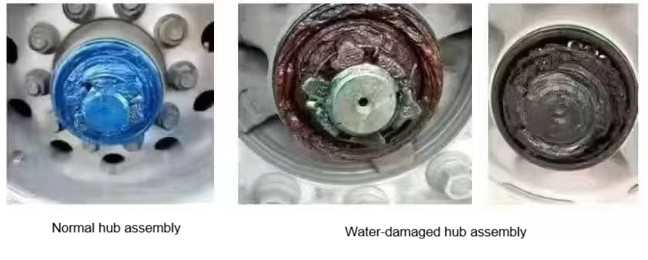
Consequences of ignored water entry: Contaminated grease loses its lubricating effect rapidly, causing bearing overheating, seizure and complete axle failure mid-transit.
Repair action: Fully drain old grease, clean all internal components, replace worn oil seals and refill with high-performance heavy-duty bearing grease.
2. Trailer Brake System Inspection (Drum & Disc Axle Versions)
Drum Brake Axles
Short-duration shallow water crossing: Perform repeated light braking while driving to evaporate residual water trapped inside brake drums.
Long deep-water submersion: Fully inspect the contact surface between brake drums and linings for rust adhesion, swelling or sticking friction material. Strip, clean and adjust brake assemblies if corrosion is found.
Disc Brake Axles
Any water exposure requires a full caliper inspection. If water has penetrated the caliper housing, moisture will corrode pistons and damage sealing gaskets. Complete disassembly, cleaning, lubrication and seal replacement is required to restore reliable braking power.
Closing Remarks
Proactive rain protection and timely post-flood maintenance drastically extend the service life of your trailer axles and brake systems, cutting unexpected repair downtime and operational costs for your logistics business.
If you have technical questions about axle maintenance or need replacement hub, brake and sealing parts, our technical support team is ready to provide professional guidance worldwide.
Related Posts
CONTACT US

Established in 2006, CHINA SINOTRUCK HK LIMITED Trailer supplies different types of products and provides relevant technical support and services to foreign customers.
Get in Touch
*We respect your confidentiality and all information are protected.