
Since 2006
Welcome to CHINA SINOTRUCK(HK) LIMITED !










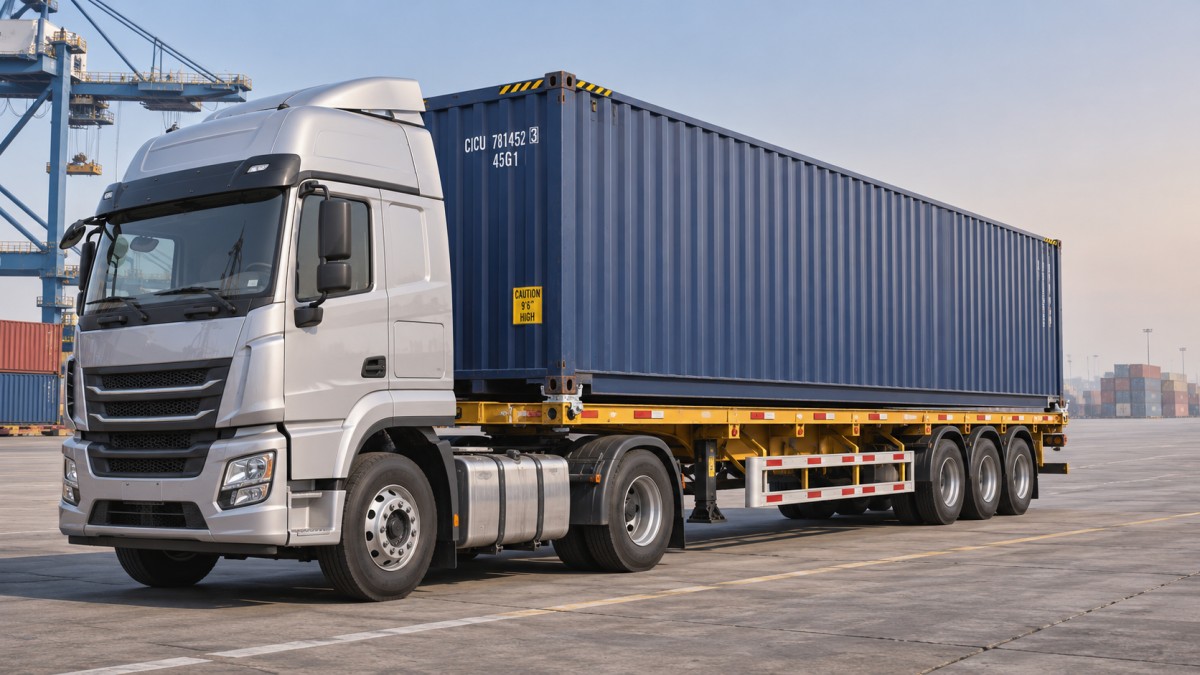
Can a flatbed container trailer carry a 40-foot container?
Yes, a flatbed container trailer can carry a 40-foot container, provided its deck dimensions, twist-lock configuration and payload rating are suitable for the load. Confirming compatibility involves more than matching container length: axle loads, chassis strength, container weight and applicable road regulations also matter. A trailer that accepts the box at a terminal is not necessarily legal or safe for every loaded journey.
Start with the container, not just the trailer length
A standard 40-foot container is approximately 12.2 metres long, but an advertised 12-metre trailer should not automatically be ruled in or out on that description alone. Overall trailer length, usable deck length and the spacing between container locks are different measurements. Ask for a dimensioned drawing showing the lock positions and the intended container overhang, if any.
The container type matters as well. A high-cube container has the same basic footprint as a standard-height box, but it increases overall vehicle height. Refrigerated and other specialised containers may introduce equipment clearances or weight distributions that need separate review. Check the actual container specification rather than assuming every 40-foot unit presents the same operating conditions.
Also establish how the container will be loaded. A terminal crane or reach stacker needs clear access to the lifting points, and the trailer must be positioned so the container can be lowered onto the locks without forcing it into place. Practical loading clearance can become a constraint at a warehouse even when the trailer works at a port.
Check the locks and support points
The container’s lower corner fittings need to align with compatible, serviceable twist locks on the trailer. Confirm that the locks are designed for the intended container position, engage fully and can be secured against unintended release. A deck long enough to hold the box is not a substitute for a proper restraint arrangement.
Support is just as important as restraint. The trailer structure must transfer the loaded container’s forces into the chassis through the intended support points. A general-purpose flatbed may have a timber or steel deck, but that does not prove the deck, crossmembers or lock mountings are suitable for concentrated container loads. Request the manufacturer’s approved loading arrangement, particularly if locks have been added after the trailer was built.
Before dispatch, inspect for damaged or seized locks, cracked welds, distorted supports and container corner fittings that prevent positive engagement. A container sitting visibly flat can still have a lock that has not turned into its secured position.
Payload is only one part of the weight calculation
The load on the trailer includes the container’s tare weight as well as its cargo and any packing or securing equipment. Compare that total with the trailer’s permitted payload, then check the coupled vehicle’s gross mass and individual axle loads against the applicable limits. The trailer rating alone does not establish that the tractor, tyres, axles, coupling or road route can accept the same load.
Load distribution inside the container can change the answer. Heavy cargo concentrated towards the front may put excessive load on the tractor’s drive axle or coupling; cargo concentrated towards the rear may overload the trailer axles or reduce the load on the tractor. Where the cargo position is uncertain, obtain a loading plan and verify axle weights on a weighbridge before committing to regular service.
The centre of gravity deserves attention too. A high-cube box is not automatically unstable, but heavy cargo stacked high can reduce stability during cornering, braking or evasive manoeuvres. Securing the container to the trailer does not secure the cargo inside it; the shipper’s internal stowage and restraint remain relevant.
Flatbed or skeletal chassis?
A flatbed offers flexibility when a fleet also carries other suitable freight. A skeletal chassis is purpose-built around container support and locking points, which may make sense for repeated movements between ports, depots and warehouses. Neither layout removes the need to verify axle loading, structural ratings or road compliance.
For example, the 12m 2-Axle Skeletal Semi Trailer is presented as an option for one 40-foot container or two 20-foot containers. Its listed overall dimensions are 12,500 × 2,500 × 1,450 mm. However, the supplied description refers to a two-axle chassis while the technical data lists three axles. Treat that as an unresolved specification, not a choice between equivalent configurations. Request the drawing, axle layout and rating for the exact unit before assessing it.
The same caution applies to the listed loading capacity of up to 60 tonnes: it should not be read as a permissible container weight on a particular route. Confirm what the figure covers, the conditions under which it applies and the legal limits for the complete combination.
What to confirm before approving a combination
A useful technical review brings the trailer drawing, container data and route requirements together. The following points tend to reveal problems before a loaded vehicle reaches the gate:
- Confirm the container’s actual gross weight and, where available, its cargo distribution—not just the maximum weight marked on the box.
- Match the container footprint to the approved lock and support positions, including the arrangement for two 20-foot containers if that flexibility is required.
- Check axle, tyre, suspension, coupling and tractor ratings for the intended loaded combination.
- Verify overall height, width, length, gross mass and axle loads against the rules and physical restrictions on the planned route.
- Review the proposed loading and unloading method, including terminal equipment access and ground conditions.
CHINA SINOTRUCK(HK) LIMITED Trailer, established in 2006, supplies trailers to overseas markets and provides technical support. For an export project, the useful next step is to request unit-specific drawings and ratings for the destination and intended tractor. A clear answer on lock layout, axle configuration and permitted loads is more valuable than a general statement that the trailer “fits a 40-foot container.”
Related Posts
- ▶ Is a flatbed container trailer suitable for non-container cargo?
- ▶ What causes uneven tire wear on a flatbed container trailer?
- ▶ When does a flatbed container trailer need a reinforced deck?
- ▶ How to check twist lock alignment on a flatbed container trailer
- ▶ Can a flatbed container trailer carry a 40-foot container?
- ▶ 14m 3-Axle Gooseneck Lowbed Trailer for Nigeria: Meeting Real Heavy Equipment Transport Needs
- ▶ Conquer Africa's Rugged Terrain: 14m 3-Axle Gooseneck Low Bed Trailer, the Ultimate 40-Ton Heavy Machinery Transport Solution
- ▶ Sizing a 60,000L Gooseneck Fuel Tanker for Multi-Stop Station Deliveries
- ▶ Slow Unloading on a 60,000L Gooseneck Fuel Tanker: Diagnostic Checks
- ▶ Aluminum or Steel for a 60,000L Gooseneck Fuel Tanker?
CONTACT US

Established in 2006, CHINA SINOTRUCK(HK) LIMITED Trailer supplies different types of products and provides relevant technical support and services to foreign customers.
Get in Touch
*We respect your confidentiality and all information are protected.