
Since 2006
Welcome to CHINA SINOTRUCK(HK) LIMITED !










When does a flatbed container trailer need a reinforced deck?
A flatbed container trailer needs a reinforced deck when the intended cargo or loading method imposes local forces beyond the deck’s verified capacity. Total payload alone does not answer that question: a trailer capable of carrying a heavy container may not be suitable for a smaller machine supported on narrow feet or for a forklift operating on the platform.
The decision starts with the load path. Container corner castings, machinery skids and forklift wheels transfer weight into different parts of the trailer. Reinforcement is justified when the existing deck, crossmembers, connections or supporting frame cannot safely carry the specified loads under the intended operating conditions.
Container loads and deck loads are not interchangeable
An ISO container is generally supported and secured at designated corner fittings. Its weight is transferred into the trailer through the container supports and underlying frame, rather than being assumed to act uniformly over the entire deck. The trailer still needs adequate container supports, locking devices, frame strength and axle capacity, but the presence of a heavy container does not by itself prove that the deck plating needs reinforcement.
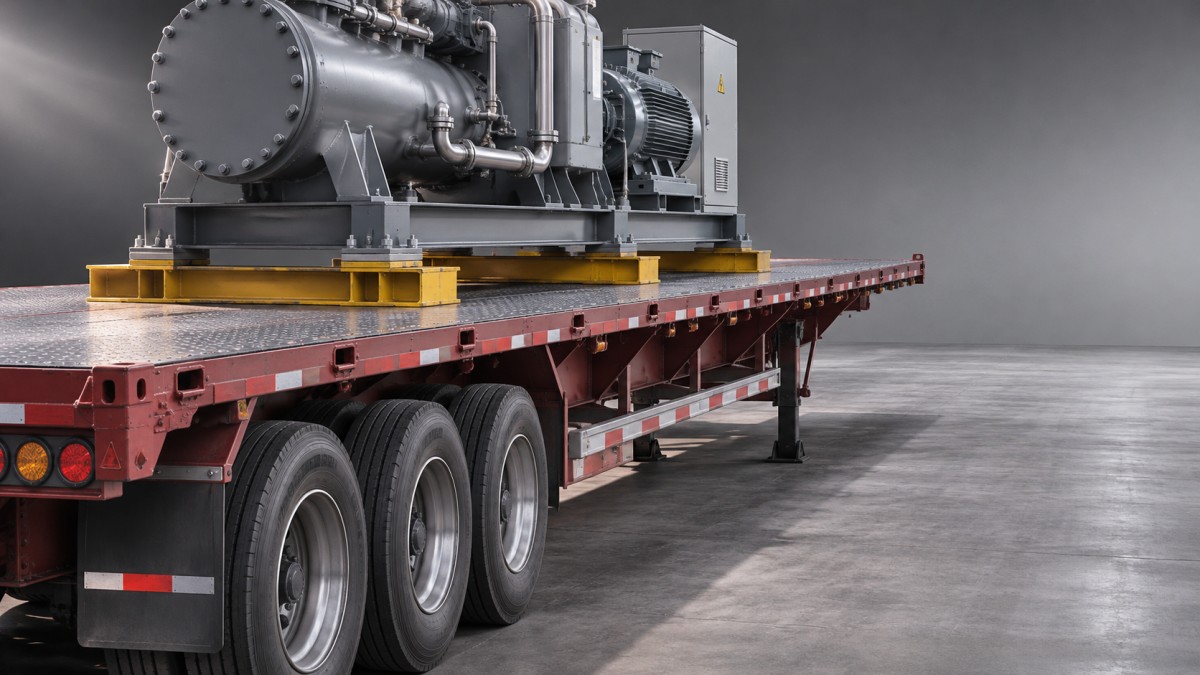
A flatbed used for machinery, steel sections or other non-containerized freight works differently. Cargo may bear directly on the floor between crossmembers, on a small number of timber bearers, or on individual feet. Those contact points can bend deck plates or floorboards locally, overload crossmembers, or introduce forces into areas not intended to carry them.
This distinction also affects trailer selection. A skeleton chassis is intended to support containers on its frame rather than provide a continuous cargo floor. For example, the 3 Axle 20Ft Skeleton Trailer is described as a skeleton-frame trailer for 20-foot containers. Its stated gross capacity and beam dimensions do not establish a deck load rating or make it a substitute for a flatbed carrying machinery directly on a floor.
When concentrated cargo makes reinforcement necessary
A reinforcement assessment is particularly important when cargo weight is carried through a small footprint. Examples include a machine on four leveling feet, a transformer on short skids, or a steel coil on a cradle. In each case, the relevant load is not only the cargo’s total mass but also the force at each contact, the size and location of the contact area, and the structure beneath it.
Equal distribution between supports should not be assumed. A machine’s center of gravity may be offset, and an uneven floor or stiff skid can cause one support to carry more than its nominal share. The supplier needs the cargo drawing or, at minimum, the weight, center of gravity, support positions and dimensions, together with any expected variation during transport.
Compare those support locations with the trailer layout. A foot directly above a main beam has a different load path from one resting midway between crossmembers. Even when the local floor can resist indentation, the crossmember below it and its connection to the main beam must carry the resulting force. Reinforcing the floor plate alone will not correct an inadequate supporting frame.
Load-spreading beams or appropriately sized timber mats can reduce local pressure and transfer force to stronger parts of the structure. They are not automatically equivalent to a reinforced deck: their stiffness, bearing area, placement and stability must be compatible with both the cargo and the trailer. The proposed arrangement should be reviewed as part of the load case, not left to improvisation at the loading site.
Forklift loading can govern the deck design
A trailer that carries its stationary cargo satisfactorily may still be unsuitable for a loaded forklift. Wheel loads can be substantially higher than suggested by the forklift’s own weight because the front axle carries the load and a changing share of the machine’s weight. The wheels also apply forces over relatively small contact areas as they move across the deck.
The design case should identify the forklift model, its operating weight, maximum load, relevant axle or wheel loads, tire type and intended travel path. The loading arrangement matters: a wheel passing between crossmembers, turning on the deck or crossing a joint may create a more demanding local condition than a stationary cargo load.
The transition from dock or ramp to trailer deserves separate attention. Ramp ends and other interfaces can concentrate forces, while changes in trailer height or support conditions can affect the loading operation. Confirm the allowable loading configuration and any limits on forklift access with the trailer and loading-equipment suppliers. A reinforcement specified only for stationary cargo should not be assumed to cover vehicle traffic.
Specify the load case before specifying thicker steel
“Heavy-duty deck” is not a usable acceptance criterion unless the supplier defines what it means. A thicker plate may improve local resistance, but capacity also depends on plate support, crossmember spacing and section, welds, main beams and the condition of the complete assembly. Reinforcement can be local, along wheel paths, beneath defined cargo supports or across a larger deck area; the right scope follows from the intended load.
A purchase specification should give the supplier enough information to check the most demanding conditions, including:
- Cargo: maximum weight, dimensions, center of gravity, support footprint and support spacing.
- Loading: crane placement or forklift access, wheel loads, travel paths and any ramp or dock arrangement.
- Transport: intended routes and operating conditions, including effects of braking, turning and road-induced movement.
- Restraint: tie-down locations and required restraint arrangement, including forces transmitted into the trailer structure.
- Variations: whether different cargo footprints or loading equipment must also be accommodated.
Ask for the permissible load and the conditions attached to it: contact area, support spacing, loading position and whether the rating applies to static cargo, moving wheels or both. A uniformly distributed load rating cannot be converted into an allowable point load without a structural assessment. Equally, a stated axle capacity does not establish what the deck can carry locally.
Request drawings showing the deck construction, crossmember arrangement and reinforced zones, together with the supplier’s calculation or test basis for the specified cases. The assessment should address the deck, underlying members and their connections as a system. If the intended cargo sits outside the stated conditions, the rating is not sufficient evidence for that use.
Check the effect on usable payload and operation
Reinforcement adds weight. Before approving it, check the resulting unladen mass and calculate the remaining payload against the trailer’s approved limits and the applicable limits for the tractor-trailer combination and route. Cargo position also changes axle and kingpin loads; staying below a quoted overall capacity does not ensure that individual axle or coupling limits are respected.
Additional structure can also affect deck height, usable width, container fittings or the placement of tie-down points. If the trailer must alternate between containers and machinery, confirm that the reinforcement and cargo supports do not interfere with container seating or locking. Reinforced areas should be identifiable on the supplied drawings so that operators know where the approved loads may be placed.
The purchase decision is therefore not simply reinforced versus standard. A standard deck is adequate when its documented ratings cover every specified cargo and loading case. Where they do not, the options are to change the loading arrangement, use a verified load-spreading system, specify targeted reinforcement or select a trailer designed for the duty. The acceptable choice is the one supported by a complete load case and a verifiable structural rating.
Related Posts
- ▶ Is a flatbed container trailer suitable for non-container cargo?
- ▶ What causes uneven tire wear on a flatbed container trailer?
- ▶ When does a flatbed container trailer need a reinforced deck?
- ▶ How to check twist lock alignment on a flatbed container trailer
- ▶ Can a flatbed container trailer carry a 40-foot container?
- ▶ 14m 3-Axle Gooseneck Lowbed Trailer for Nigeria: Meeting Real Heavy Equipment Transport Needs
- ▶ Conquer Africa's Rugged Terrain: 14m 3-Axle Gooseneck Low Bed Trailer, the Ultimate 40-Ton Heavy Machinery Transport Solution
- ▶ Sizing a 60,000L Gooseneck Fuel Tanker for Multi-Stop Station Deliveries
- ▶ Slow Unloading on a 60,000L Gooseneck Fuel Tanker: Diagnostic Checks
- ▶ Aluminum or Steel for a 60,000L Gooseneck Fuel Tanker?
CONTACT US

Established in 2006, CHINA SINOTRUCK(HK) LIMITED Trailer supplies different types of products and provides relevant technical support and services to foreign customers.
Get in Touch
*We respect your confidentiality and all information are protected.