
Since 2006
Welcome to CHINA SINOTRUCK(HK) LIMITED !










What causes uneven tire wear on a flatbed container trailer?
Uneven tire wear on a flatbed container trailer usually points to a difference in pressure, loading, wheel alignment or component condition. The location of the wear matters: damage across both shoulders suggests a different problem from wear confined to one edge, while a single irregular tire calls for a different inspection from a pattern repeated across several axles.
Do not assume that replacing the tire will solve the problem. If the underlying cause remains, the replacement can wear in the same way. A pressure check and a careful comparison of all wheel positions are useful starting points, but severe damage, exposed cords or a suspected loose wheel require the trailer to be taken out of service for inspection.
Read the wear pattern before adjusting anything
Inspect the full tread width and both sidewalls, including the inner tires on dual-wheel assemblies. Record the axle and wheel position of each affected tire. Comparing the left and right sides, as well as the front and rear axles, helps distinguish a local problem from one affecting the trailer as a whole.
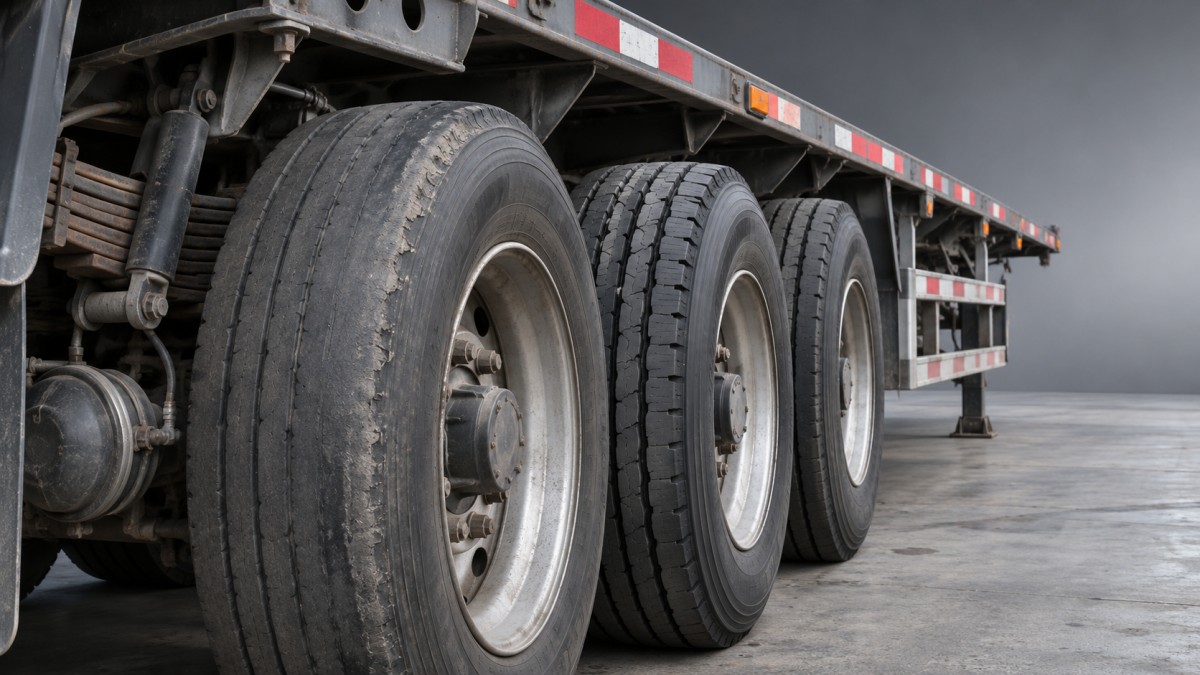
- Both shoulders wearing faster than the center: Check for underinflation and excessive load. Running with insufficient pressure increases sidewall flex and heat buildup.
- Center wearing faster than the shoulders: Overinflation is one possible cause. Compare the cold pressure with the tire manufacturer’s recommendation for the actual load rather than releasing air based on appearance alone.
- One shoulder or one edge wearing rapidly: Suspect an alignment, axle, bearing or suspension problem. Uneven load distribution and operating conditions can also affect the pattern.
- Feathering, where tread ribs feel smoother in one direction than the other: This can indicate the tire is scrubbing sideways because of an alignment issue. Check the direction by running a hand across the tread, taking care around damaged rubber.
- Scalloped or cupped patches: Irregular contact with the road can be associated with worn suspension parts, wheel-end problems, tire or wheel irregularities, or imbalance. The pattern alone does not identify which component is responsible.
- A flat spot in one area: A wheel that has locked under braking is a possible cause. Check for a brake fault or an operational event that could have stopped the wheel from rotating.
Wear patterns are clues, not conclusive diagnoses. A tire can develop more than one pattern, and damage from an earlier problem may remain visible after that problem has been corrected. Marking and recording the affected positions makes it easier to tell whether wear is progressing.
Pressure and dual-tire mismatch
Check pressure with a calibrated gauge when the tires are cold, before the journey or after they have cooled. Use the tire manufacturer’s pressure guidance for the tire size and measured load, without exceeding the applicable tire, rim or vehicle limits. The maximum pressure molded on a tire sidewall is not automatically the correct operating pressure for every load.
On a dual assembly, one tire can be underinflated without looking obviously flat. It may carry less of the load while its partner carries more. Differences in tire size, outside diameter or wear depth can also prevent the pair from sharing the load properly. Check both tires individually, including the inner valve, and follow the tire manufacturer’s limits for matching dual tires.
If one tire repeatedly loses pressure, investigate the valve, valve extension, wheel and tread for leaks or damage. Do not simply add air every day and continue operating. A tire that has been run significantly underinflated may have internal damage; it should be assessed by a qualified tire professional before reinflation or return to service. Never bleed pressure from a hot tire to make it match a cold-pressure setting.
Axle alignment and suspension wear
Trailer axles need to track correctly behind the tractor. If an axle is out of alignment, its tires can scrub across the road instead of rolling freely. Feathered tread, rapid shoulder wear or a trailer that appears to track to one side can justify an alignment inspection. Tracking observations are only a warning sign: road camber, turning and loading can also affect how the trailer appears to follow.
Alignment may change after an impact with a curb or pothole, but it can also be affected by loose or worn suspension parts. Inspect spring hangers, bushes, equalizers, torque rods and mounting hardware as applicable to the suspension design. A broken spring leaf, shifted axle or damaged hanger can change wheel position and load sharing.
Wheel-end condition matters as well. Excessive bearing play or a damaged hub can allow a wheel to run incorrectly and may create heat or irregular wear. A hot wheel end, unusual noise or visible looseness warrants prompt attention; the cause could involve a bearing, brake or another component. Avoid touching a suspected hot hub or brake directly.
Alignment measurements and adjustments should be carried out on suitable level equipment, using the trailer manufacturer’s specifications. Replacing a tire or adjusting alignment without repairing loose or damaged components is unlikely to provide a lasting correction.
Container position and axle loading
A container can be secured correctly at its locking points and still place an uneven load on the trailer. The weight distribution inside the container matters as much as its external position: heavy cargo concentrated toward one end or side can increase the load carried by particular axles or tires. A trailer’s total load being within its rating does not guarantee that every axle and tire is within its own limit.
Where axle-load scales are available, weigh the combination in its operating condition and compare the readings with the applicable vehicle, axle and tire limits. If side-to-side imbalance is suspected, individual wheel-position weights are more informative where suitable equipment is available. Reposition the cargo only when it is safe and practical to do so, then recheck the load and container restraints.
Multi-axle trailers also scrub tires during tight turns, especially in ports and logistics yards. Some lateral movement across the pavement is a normal consequence of turning; repeated tight maneuvers can accelerate wear, but they should not be used to dismiss a pronounced difference at one wheel position. A loaded trailer that spends much of its time turning deserves closer tread checks than one operating mainly on straight roads.
For example, the 40ft 4-Axle Container Flatbed Semi-Trailer is specified with four axles and mechanical suspension. On a configuration like this, comparing wear across all axle positions helps identify whether the issue is concentrated at one wheel, shared by an axle or distributed across the running gear. The stated trailer payload does not replace checks against actual axle and tire loads.
Brakes, damaged wheels and other local causes
When one tire has an isolated flat spot or wears much faster than its neighbors, inspect that wheel position closely. A dragging brake can generate heat and accelerate tire damage; a brake that locks can scrape away tread in one area. Brake imbalance can also make wear more severe on some positions than others. Brake diagnosis and adjustment should be handled by a qualified workshop using the correct procedures for the system.
A bent rim, damaged tire casing or assembly that does not run true can create vibration and irregular contact. Debris trapped between dual tires can damage sidewalls, while cuts, bulges or exposed reinforcement indicate a safety issue rather than ordinary tread wear. Remove the trailer from service if damage makes continued operation unsafe, and have the tire or wheel assessed.
What to do when uneven wear appears
Start by documenting the position, tread condition and cold pressure of every tire. Check whether the affected tire has a matching partner, whether the wear is present on the same side of other axles, and whether the container load or route has recently changed. A photograph and tread-depth measurements across the inner, center and outer tread can provide a useful baseline.
If pressure is incorrect, correct it only after considering whether the tire may have suffered damage. If a pattern points to alignment, suspension, brakes or a wheel end, arrange the appropriate inspection rather than relying on tire rotation to disguise the symptom. Rotation may help manage wear where the tire and vehicle manufacturers permit it, but it cannot correct a mechanical fault.
After repairs, keep the recorded wheel-position information and inspect again during routine pre-trip checks. Continued rapid wear at the same position is a reason to revisit the diagnosis, even if the replacement tire initially looks normal.
Related Posts
- ▶ Is a flatbed container trailer suitable for non-container cargo?
- ▶ What causes uneven tire wear on a flatbed container trailer?
- ▶ When does a flatbed container trailer need a reinforced deck?
- ▶ How to check twist lock alignment on a flatbed container trailer
- ▶ Can a flatbed container trailer carry a 40-foot container?
- ▶ 14m 3-Axle Gooseneck Lowbed Trailer for Nigeria: Meeting Real Heavy Equipment Transport Needs
- ▶ Conquer Africa's Rugged Terrain: 14m 3-Axle Gooseneck Low Bed Trailer, the Ultimate 40-Ton Heavy Machinery Transport Solution
- ▶ Sizing a 60,000L Gooseneck Fuel Tanker for Multi-Stop Station Deliveries
- ▶ Slow Unloading on a 60,000L Gooseneck Fuel Tanker: Diagnostic Checks
- ▶ Aluminum or Steel for a 60,000L Gooseneck Fuel Tanker?
CONTACT US

Established in 2006, CHINA SINOTRUCK(HK) LIMITED Trailer supplies different types of products and provides relevant technical support and services to foreign customers.
Get in Touch
*We respect your confidentiality and all information are protected.