
Since 2006
Welcome to CHINA SINOTRUCK(HK) LIMITED !










Is a flatbed container trailer suitable for non-container cargo?
Is a flatbed container trailer suitable for non-container cargo?
A flatbed container trailer can carry more than shipping containers, but its suitability for non-container cargo depends on the load, trailer design, and securing method. Operators may use one to transport steel, machinery, timber, or other oversized goods when weight limits and local regulations allow. Understanding load distribution, tie-down points, and safe operating practices is essential before putting the trailer to work. This guide explains what to check and how to assess whether a flatbed container trailer is right for your cargo.
Start with the trailer, not just the cargo weight
A container flatbed may look like an all-purpose platform, but configurations vary. Some have a continuous deck; others rely more heavily on the main beams and container support areas. A trailer intended to carry containers at defined corner positions is not automatically suitable for a machine resting on four small feet.
Before accepting a non-container load, confirm the usable deck dimensions, deck construction, available load-bearing areas and rated securing points. Ask the manufacturer or supplier about any concentrated-load limits and whether the proposed support arrangement is acceptable. Visible steel thickness alone does not tell you how much weight a particular section of deck can carry.
Also check for protruding twist locks. They may interfere with skids or prevent cargo from sitting flat. Do not assume they can be removed or used as general-purpose lashing points; their intended function is to secure compatible containers.
Which loads are realistic candidates?
Steel sections, bundled timber, crated equipment and machinery on substantial skids can be practical loads, provided the deck and restraint arrangement suit them. The important distinction is how each load contacts the trailer and how it can move during braking, cornering or travel over uneven roads.
A long bundle of steel, for example, needs suitable supports and restraint against forward movement. Loose pieces within the bundle may shift even when the bundle itself appears tightly strapped. Timber can settle as the vehicle travels, reducing strap tension. Machinery may have a high centre of gravity, fragile components and only a few approved lifting or lashing locations. Each calls for a different plan.
Some freight is a poor fit. Loose bulk material generally needs containment, not an open flat deck. Coils, wheeled vehicles and large cylindrical items may require purpose-designed cradles, chocks or restraints. If the trailer lacks suitable attachment points or the cargo cannot be supported without damaging the deck, another trailer type may be the safer choice.
Payload capacity is not a loading plan
A load can be below the trailer’s rated payload and still overload an axle group, the tractor coupling or a small area of deck. Weight position matters. Placing a heavy machine too far forward can put excessive load on the tractor; placing it too far back can overload trailer axles or leave insufficient load on the drive axles.
The 5-Axle Flatbed Semi-Trailer illustrates the distinction. Its stated rated payload is 55,000 kg, and its five-axle layout and reinforced frame are intended for container transport, including work on African highways. Those figures do not establish that a 55,000 kg machine can be placed anywhere on its deck. The permissible load depends on its footprint, position, tractor combination, axle limits and route requirements.
For concentrated cargo, properly selected timber dunnage or engineered spreader beams may distribute forces over a larger supported area. Their size, orientation and placement need to suit both the cargo and the trailer structure. A few boards placed wherever they fit are not a substitute for a confirmed support plan.
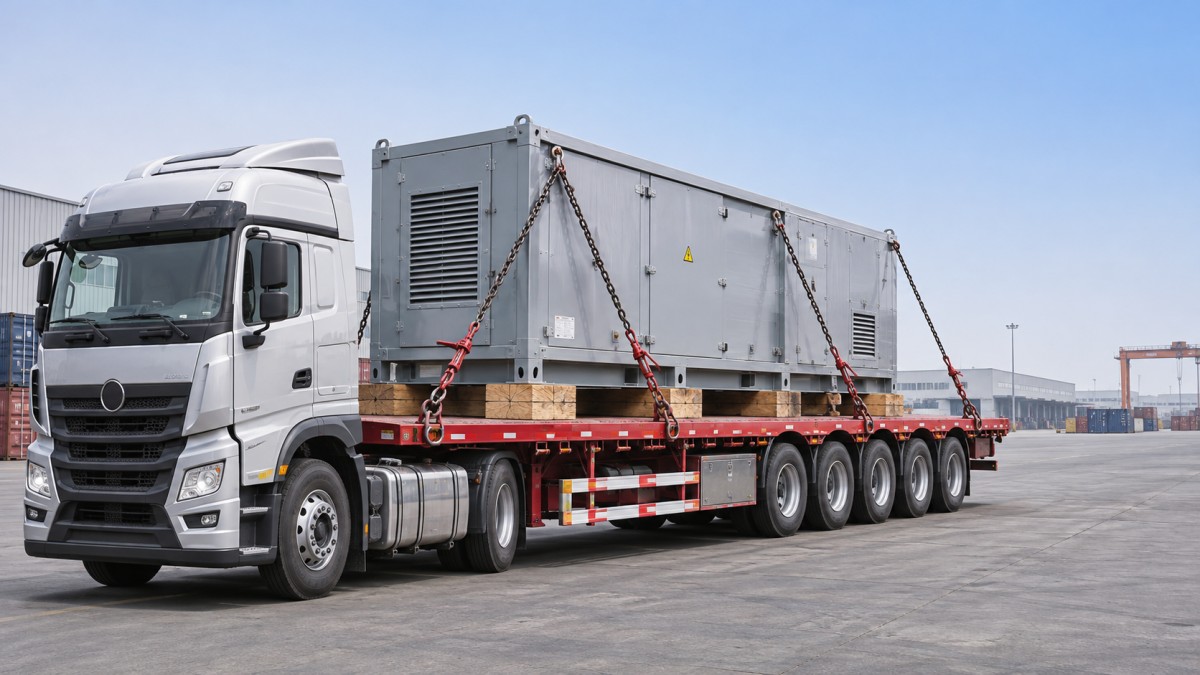
Where the load is close to a limit, use actual weights rather than estimates. A weighbridge check of the loaded combination and axle groups can reveal a distribution problem that is not obvious from looking at the deck. If necessary, reposition the cargo and weigh again before leaving.
Restraint needs more than a strap over the top
The restraint system must address movement forward, rearward, sideways and, where relevant, tipping or lifting. Depending on the load and applicable rules, that may involve direct lashings, tie-downs, blocking, chocks or a combination. Friction can help, but its contribution depends on the contacting surfaces and conditions; a wet, oily or damaged surface changes the situation.
Use rated, undamaged chains, straps and attachment points suitable for the forces involved. Check their markings and the applicable cargo-securing requirements; do not treat breaking strength as the permitted working load. Protect webbing from sharp steel edges with appropriate edge protection, and avoid routing restraints across parts of a machine that can bend, rotate or detach.
An operator should be able to answer a simple question for every restraint: what movement is it preventing? If the answer is unclear, the plan deserves another look. For example, a vertical strap may press a load onto the deck, but it is not automatically equivalent to a correctly positioned direct lashing or a rated forward block.
Recheck the load and restraint tension after setting off when it is safe and permitted to stop, and again during the journey as conditions require. Dunnage can compress, timber can settle and a load can shift slightly even when nothing was visibly loose at departure.
Check the whole route before loading
Non-container cargo can exceed normal width, height or length limits even when its weight is acceptable. Measure the loaded vehicle, not just the cargo: deck height, supports, overhang and restraint hardware all affect the final dimensions. Confirm the rules for each jurisdiction on the route, including permits, markings, escorts and travel restrictions where applicable.
Road and site conditions matter too. A tall machine may clear a highway bridge but not a depot entrance. Uneven loading ground can make a high-centre-of-gravity item unstable before it is secured. At delivery, make sure suitable unloading equipment and space are available; releasing restraints on a slope or without a plan can create a hazard.
For an unfamiliar load, send the supplier the cargo weight, dimensions, centre-of-gravity information, support footprint and proposed route before committing the trailer. CHINA SINOTRUCK(HK) LIMITED Trailer, established in 2006, supplies transport equipment and technical support to overseas customers, including in Africa, Southeast Asia, the Middle East and South America. Confirming the specific trailer configuration and its suitable support and tie-down arrangements is more useful than relying on a catalogue payload figure alone.
Related Posts
- ▶ Is a flatbed container trailer suitable for non-container cargo?
- ▶ What causes uneven tire wear on a flatbed container trailer?
- ▶ When does a flatbed container trailer need a reinforced deck?
- ▶ How to check twist lock alignment on a flatbed container trailer
- ▶ Can a flatbed container trailer carry a 40-foot container?
- ▶ 14m 3-Axle Gooseneck Lowbed Trailer for Nigeria: Meeting Real Heavy Equipment Transport Needs
- ▶ Conquer Africa's Rugged Terrain: 14m 3-Axle Gooseneck Low Bed Trailer, the Ultimate 40-Ton Heavy Machinery Transport Solution
- ▶ Sizing a 60,000L Gooseneck Fuel Tanker for Multi-Stop Station Deliveries
- ▶ Slow Unloading on a 60,000L Gooseneck Fuel Tanker: Diagnostic Checks
- ▶ Aluminum or Steel for a 60,000L Gooseneck Fuel Tanker?
CONTACT US

Established in 2006, CHINA SINOTRUCK(HK) LIMITED Trailer supplies different types of products and provides relevant technical support and services to foreign customers.
Get in Touch
*We respect your confidentiality and all information are protected.