
Since 2006
Welcome to CHINA SINOTRUCK(HK) LIMITED !










Can a 45ft skeletal trailer carry a 40-foot container?
Can a 45ft skeletal trailer carry a 40-foot container? In many cases, yes—but compatibility depends on the trailer’s twist-lock positions, load distribution, axle ratings, and applicable road regulations.
For technical evaluators, verifying these factors is essential before specifying a trailer for container transport. This article examines the key dimensional and operational requirements to help determine whether a 45ft chassis is suitable for a 40-foot container.
What determines whether a 45ft chassis can carry a 40ft container?
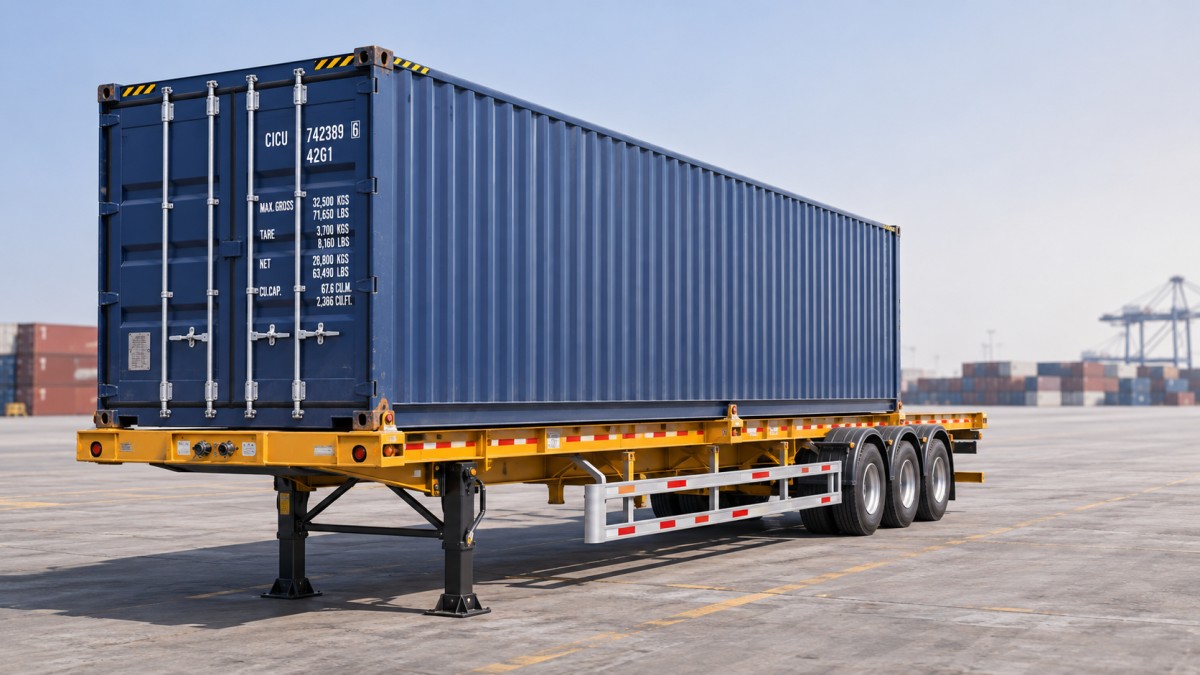
The decisive factor is whether the trailer has approved mounting and support positions for a 40-foot container. A longer chassis alone does not establish compatibility.
A suitable configuration must engage all required container corner castings with compatible locking devices and provide the support specified by the trailer and container manufacturers.
The mounted container must also sit in a position that keeps the kingpin and axle loads within their limits when coupled to the intended tractor.
Finally, the complete vehicle combination must comply with the dimensional, weight, and equipment rules that apply along the planned route.
Are the twist-lock positions correct for a 40-foot container?
A standard 40-foot ISO container is approximately 12,192 mm long, while a 45-foot container is approximately 13,716 mm long. Their end fittings therefore require different longitudinal spacing.
Some 45-foot skeletal chassis have dedicated 40-foot lock positions, adjustable locking devices, or an extendable frame. Others are configured for a different container arrangement.
Ask the supplier for a dimensional drawing showing the 40-foot container position, lock locations, support points, and the distance from each position to the kingpin.
Check the drawing against the actual trailer. All required locks must engage the container corner castings correctly, operate freely, and be secured in the locked position.
Do not rely on improvised adapters, welded extensions, or partially engaged locks. Any alternative arrangement requires documented approval from the relevant manufacturer and competent authority.
Also check whether unused locks or fittings must be retracted. Protruding hardware can prevent the container from seating correctly or interfere with loading equipment.
Where should the 40-foot container sit on the trailer?
A compatible lock pattern may allow the container to sit toward the front, rear, or another designated position. That choice affects coupling clearance and axle loads.
With the intended tractor coupled, check clearance between the container and tractor cab during turns, braking, and changes in road gradient. Include any cab-mounted equipment.
At the rear, verify the position of the container relative to the chassis, lights, underrun protection, and any applicable overhang limits.
Confirm that the container rests on its intended supports without interference. A gap, rocking movement, or unintended contact with the frame needs investigation before operation.
For trailers with sliding or extendable components, verify the prescribed position and locking method for the 40-foot configuration. Inspect the mechanism for damage and wear.
Can the trailer and tractor handle the loaded container?
Start with the container’s verified gross mass: its tare weight plus cargo, packaging, and securing materials. Compare that figure with the container’s permitted maximum gross mass.
Then assess the complete combination. The trailer payload rating, gross vehicle limits, axle ratings, tire ratings, suspension capacity, kingpin load, and tractor limits all matter.
A trailer advertised for a particular payload does not automatically carry that payload legally on every route. Tractor weight, axle spacing, and local rules can reduce usable capacity.
Request the trailer’s unladen axle and kingpin loads for the proposed configuration. Add the expected container load using the manufacturer’s load distribution method or a suitable engineering calculation.
The cargo’s center of gravity is critical. A heavy load concentrated near one end of the container can overload an axle group or the tractor coupling.
For example, a container weighing 30 tonnes does not necessarily distribute that weight evenly between the trailer axles and kingpin. Its position and cargo distribution determine the reactions.
If the cargo distribution is uncertain, obtain a loading plan or weigh the loaded combination. Compare measured axle and gross weights with every applicable limit.
Allow for operational variation, including different tractors and cargo types. A configuration that passes with one tractor may exceed an axle limit with another.
What road and operational requirements should be checked?
Check the regulations in every jurisdiction on the route, including ports and border crossings. Permitted combination length, axle loads, gross mass, and rear overhang can differ.
Measure the actual coupled combination with the intended container installed. The trailer’s nominal 45-foot designation is not a substitute for overall length or height measurements.
A standard-height 40-foot container and a high-cube container have similar corner fitting positions but different heights. Confirm bridge clearance and legal overall height for each.
Check terminal handling requirements as well. The chassis must present the container in a position that loading equipment can access and the operator can secure safely.
Before dispatch, inspect the frame, locks, tires, brakes, suspension, and lighting. Follow the manufacturer’s inspection and maintenance instructions for the specific trailer.
When might a flatbed be a better alternative?
A skeletal chassis is purpose-built around container support points. A flatbed may be useful when the same fleet also transports suitable non-containerized cargo.
For example, 3-Axle Flatbed Semi-Trailers are described for 20-foot and 40-foot containers, as well as secured cargo such as steel pipes and timber.
The stated configuration has three axles, dimensions of 12,500 × 2,500 × 1,460 mm, and a load capacity of up to 60 tonnes.
Those figures are starting points for evaluation, not proof of legal payload or container compatibility for a particular route. Confirm lock positions, axle ratings, and documentation.
The flatbed arrangement also allows crane loading and unloading from either side, subject to site access, lifting procedures, and the equipment used.
What should a technical evaluator request before approval?
Obtain a configuration drawing identifying the 40-foot lock and support positions, kingpin location, axle spacing, overall dimensions, and any required adjustable-frame settings.
Request the trailer’s rated capacities, unladen weight distribution, tire and suspension ratings, and instructions for securing the intended container type.
Confirm the tractor coupling specifications and calculate axle loads for the heaviest and most unevenly distributed loads expected in service. Verify the result by weighing where practical.
Document the route-specific legal limits and check the physical trailer against the approved specification before accepting it for container operations.
Conclusion
A 45ft skeletal trailer can carry a 40-foot container when it has the correct approved locks and supports, suitable load distribution, and sufficient component capacity.
Approve the combination only after checking its actual configuration, tractor compatibility, loaded axle weights, clearances, and the rules that apply throughout the intended route.
Related Posts
- ▶ Double Deck Car Carrier Trailer: Improve Vehicle Transport Efficiency and Reduce Costs
- ▶ Can a 45ft skeletal trailer carry a 40-foot container?
- ▶ Does a lighter flatbed container trailer increase usable payload?
- ▶ How to inspect a flatbed container trailer for frame cracks
- ▶ Is a flatbed container trailer suitable for non-container cargo?
- ▶ What causes uneven tire wear on a flatbed container trailer?
- ▶ When does a flatbed container trailer need a reinforced deck?
- ▶ How to check twist lock alignment on a flatbed container trailer
- ▶ Can a flatbed container trailer carry a 40-foot container?
- ▶ 14m 3-Axle Gooseneck Lowbed Trailer for Nigeria: Meeting Real Heavy Equipment Transport Needs
CONTACT US

Established in 2006, CHINA SINOTRUCK(HK) LIMITED Trailer supplies different types of products and provides relevant technical support and services to foreign customers.
Get in Touch
*We respect your confidentiality and all information are protected.