
Since 2006
Welcome to CHINA SINOTRUCK(HK) LIMITED !










How does a sliding axle affect 45ft skeletal trailer use?
How does a sliding axle affect 45ft skeletal trailer use?
A sliding axle can make a 45ft skeletal trailer more adaptable to varying container loads and operating conditions. By changing the axle group’s position, operators can adjust weight distribution and potentially improve compliance with local axle-load limits, while also affecting turning behavior and vehicle stability. For technical evaluators, the key is to assess these benefits alongside the sliding mechanism’s locking security, maintenance requirements and compatibility with the intended routes and cargo. This article examines how these factors influence trailer selection and day-to-day use.
What actually moves?
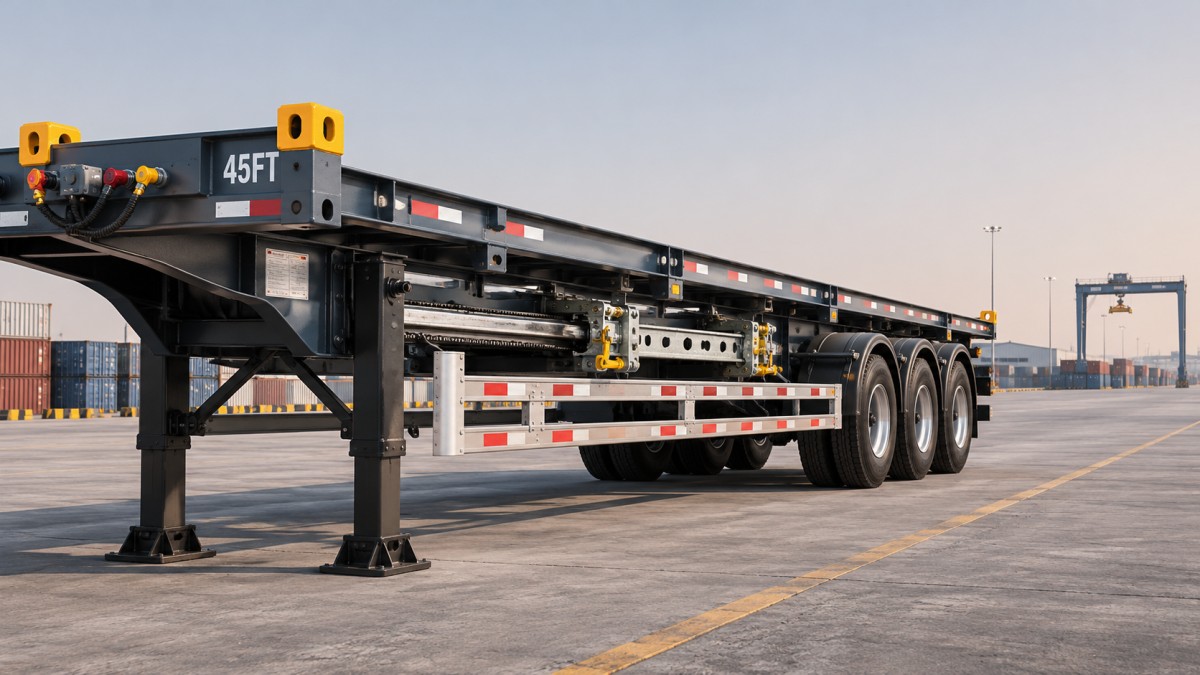
On a sliding-axle skeletal trailer, the suspension and axle group can be repositioned longitudinally relative to the main chassis, then secured at an approved position. The arrangement differs by manufacturer: the travel range, number of locking positions and method of releasing the locks must all be confirmed from the design documentation.
It is also worth distinguishing a sliding axle group from an extendable chassis. An extendable frame changes the trailer’s configuration to accommodate specified container lengths; a sliding axle group primarily changes the position of the rear support. Some designs may combine features, but one does not automatically imply the other.
Weight distribution: useful adjustment, not extra capacity
The tractor’s fifth wheel and the trailer axle group share the load imposed by the trailer and container. For a fixed cargo position, moving the axle group rearward generally shifts more of that supported load toward the tractor; moving it forward generally shifts more toward the trailer axle group. The actual result depends on the complete vehicle geometry, unladen weights and cargo centre of gravity.
This can be valuable when a container is legally within its gross mass limit but unevenly loaded, leaving one axle group overloaded. It is not a substitute for correct cargo distribution. Sliding the axles cannot reduce the combination’s total weight, increase the rated capacity of the chassis or correct every tractor steering-axle problem. A heavy load near one end of the container may still require repacking or a different transport arrangement.
For an assessment, request the manufacturer’s axle-load calculations for the intended tractor, container position and expected cargo centre of gravity. Then verify the loaded combination on a suitable weighbridge or axle scale. Check individual axle loads as well as group and gross weights: legal limits and measurement practices vary by route and jurisdiction.
Turning clearance and stability change with position
Moving the axle group forward generally shortens the distance from kingpin to axle group. That can reduce the trailer’s inward cut-in during a turn, which matters at terminal gates, narrow junctions and loading yards. The trade-off is a longer rear overhang, which can increase rear swing and create clearance problems near parked vehicles, barriers or personnel.
Moving the group rearward usually has the opposite effect: more inward cut-in and less rear overhang. Neither position should be described as universally safer. Container height, cargo distribution, suspension condition, tyre loading and road surface also influence stability and handling. A turning template or swept-path analysis should use the actual tractor and trailer dimensions at each proposed axle position.
Before specifying a wide adjustment range, consider whether the practical route actually permits the positions offered. A setting that helps at a tight depot may not be acceptable on the public-road leg because of axle loads, dimensional limits or other local requirements.
The mechanism must work beyond the drawing
The sliding assembly introduces interfaces that a fixed-axle chassis does not have: rails, locking apertures, pins or equivalent restraints, release controls and associated fasteners. Ask how positive engagement is confirmed on both sides, how partial engagement is detected, and what inspection or replacement criteria apply when components wear. The operator should not have to infer that a lock is secure merely because the release control has returned.
Movement and locking procedures also deserve attention. Confirm whether adjustment is permitted with a container loaded, what surface and vehicle restraints are required, and how the operator avoids pinch points. Brake lines, electrical cables and any suspension connections need adequate protection and travel throughout the approved range. Follow the manufacturer’s procedure rather than assuming that methods used on another trailer are interchangeable.
In service, dirt, corrosion, damaged rails or distorted locking holes can make repositioning difficult or undermine reliable engagement. A maintenance plan should identify cleaning and lubrication requirements, inspection intervals, wear limits and access to replacement parts. For fleets that rarely change operating conditions, a fixed axle group may be the simpler choice.
Match the chassis to the work, not just the container length
A 45ft designation alone does not establish compatibility. Confirm the approved container sizes, twist-lock positions and load ratings, as well as overall dimensions and clearances with the intended tractor. The trailer’s tare weight matters too: an adjustable mechanism may affect the payload available within a given gross weight limit.
The distinction between transport tasks is equally important. A skeletal chassis secures containers at designated mounting points; a fence-bodied drawbar trailer is intended for a different loading arrangement. For example, the 3-Axle Fence Drawbar Trailer is described for varied cargo on farms, construction sites and regional routes, with solid lower panels and open upper rails. It should not be treated as an equivalent container chassis without confirming the necessary securing arrangements and approvals.
CHINA SINOTRUCK(HK) LIMITED Trailer, established in 2006, supplies several categories of road transport equipment and technical support to overseas customers, including markets in Africa, Southeast Asia, the Middle East and South America. For a sliding-axle specification, the useful next step is to review a configuration drawing, axle-load calculations, locking and maintenance instructions, and the documentation applicable to the destination market. Any certification should be checked against the specific vehicle and intended use, rather than assumed from a supplier’s broader product range.
Related Posts
- ▶ How to Choose the Right Flatbed Semi Trailer for Your Fleet?
- ▶ Flatbed Semi Trailer: 5 Common Transportation Problems and Their Solutions
- ▶ Double Deck Car Carrier Trailer: Improve Vehicle Transport Efficiency and Reduce Costs
- ▶ What tie-down capacity does a 3 axle flatbed trailer need?
- ▶ How does axle spacing affect a 3 axle flatbed trailer's load limit?
- ▶ When is a 3 axle flatbed trailer better than a 2 axle model?
- ▶ How to distribute a concentrated load on a 3 axle flatbed trailer
- ▶ What determines the unladen weight of a 45ft skeletal trailer?
- ▶ How does a sliding axle affect 45ft skeletal trailer use?
- ▶ How to identify a worn twist lock on a 45ft skeletal trailer
CONTACT US

Established in 2006, CHINA SINOTRUCK(HK) LIMITED Trailer supplies different types of products and provides relevant technical support and services to foreign customers.
Get in Touch
*We respect your confidentiality and all information are protected.