
Since 2006
Welcome to CHINA SINOTRUCK(HK) LIMITED !










What determines the unladen weight of a 45ft skeletal trailer?
The unladen weight of a 45ft skeletal trailer affects payload capacity, axle loading, fuel consumption and regulatory compliance. Yet two trailers designed to carry the same container may have noticeably different empty weights. The difference is not explained by length alone: frame design, steel selection, running gear and fitted equipment all contribute.
For a technical evaluator, the more important question is often not simply “How much does it weigh?” but “What is included in that figure, and what operating limits remain after the container is loaded?”
What does unladen weight include?
Unladen weight, often called tare weight, is the mass of the trailer without its cargo. For a skeletal trailer, that normally means the chassis and its installed components, including axles, suspension, wheels, tyres, brakes, landing gear, coupling equipment and container locks.
However, quoted tare values are only comparable when their measurement boundaries match. A manufacturer may include a spare wheel, carrier, toolboxes or other optional equipment in one specification but exclude them from another. Whether the value is a calculated design figure or a measured production weight also matters.
Ask for the trailer configuration associated with the stated weight, the weighing method and any applicable tolerance. If an operational or legal definition of unladen weight is required, check the rules in the country of registration or operation rather than assuming that a sales-sheet definition applies.
Why the chassis accounts for so much of the weight
The skeletal frame supports a container at designated load-transfer points rather than carrying it on a full-length deck. Main beams, crossmembers, bolster structures and twist-lock supports must transfer those forces through the chassis to the suspension and kingpin. Reinforcement around concentrated loads can add substantial mass even when the trailer looks visually simple.
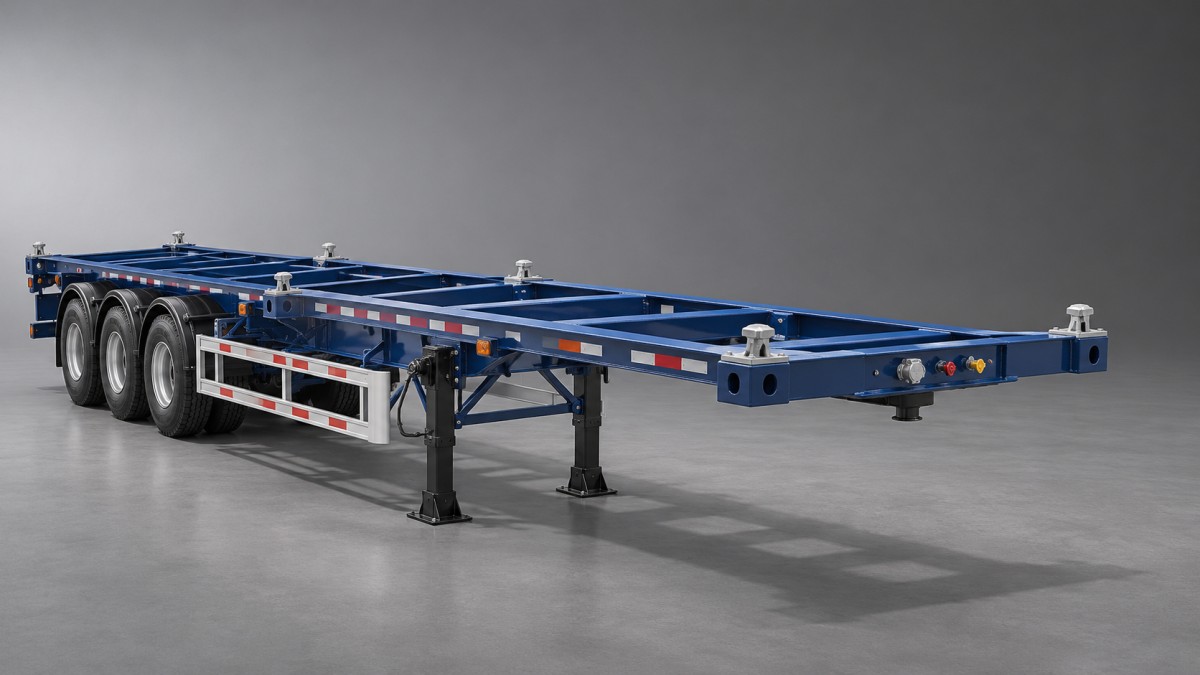
Beam depth, material thickness, flange width and crossmember spacing all affect the result. So do local reinforcements around the axle group, landing gear and coupling plate. A chassis intended for demanding road conditions or repeated heavy-duty service may use additional reinforcement; that choice should be assessed against its design load and expected duty, not judged by weight alone.
Steel grade is another variable. Higher-strength steel can allow material to be removed from selected areas, but only where the design still meets requirements for stiffness, fatigue life, buckling resistance and weld performance. The steel designation by itself does not prove that a lighter frame is suitable for the intended service.
Running gear and equipment: small choices that add up
Axles and suspension form a major part of trailer tare. An additional axle generally adds the axle assembly, wheels, tyres, brakes and associated suspension hardware. It may also change how loads are distributed and what is permitted on the intended route. The lightest axle configuration is therefore not automatically the one that provides the most usable payload.
Suspension selection also affects both mass and operating characteristics. Mechanical spring and air suspension systems have different assemblies and may be specified for different maintenance conditions, ride requirements and regulatory environments. Compare complete installed systems rather than isolated component weights.
Other items worth checking include:
- Wheels and tyres: Size, wheel material, tyre construction and the number of fitted wheels influence tare. Include any spare in the comparison if it travels with the trailer.
- Brakes and controls: Brake chambers, air reservoirs, valves, piping and electronic control equipment add weight according to the chosen specification.
- Container fittings: The number and location of twist locks, adjustable supports or sliding arrangements depend on the container configurations the trailer is designed to accept.
- Operating accessories: Landing legs, mudguards, side guards, lighting, toolboxes and protection equipment may differ between export destinations and customer orders.
These differences are easy to miss when comparing headline figures. A quotation for a basic chassis and one for a road-ready trailer may not describe equivalent products, even if both are labelled as 45ft skeletal designs.
From trailer tare to usable payload
A preliminary trailer-level calculation is:
Potential payload = permitted loaded trailer mass − trailer unladen mass
The permitted loaded trailer mass must reflect the applicable vehicle rating and legal limits. In practice, this calculation alone is not enough. The tractor unit, combination mass limit, kingpin load and individual axle or axle-group limits can reduce the payload that can actually be carried. A container’s own tare is part of the payload on the trailer, so it must be included alongside the goods inside.
As an illustration, if a trailer is permitted to operate at a loaded mass of 38,000 kg and its verified unladen mass is 5,000 kg, the preliminary payload is 33,000 kg. A container weighing 4,000 kg empty would leave 29,000 kg for its contents before checking combination, axle, kingpin and route limits. These figures illustrate the arithmetic only; they are not ratings for a particular trailer.
Load position is just as important as total mass. Two containers with the same gross weight can produce different axle and kingpin loads if their contents are distributed differently. For a technical assessment, request the manufacturer’s load-distribution information and confirm the intended tractor coupling position and fifth-wheel rating.
Which specifications should evaluators request?
A useful comparison begins with an agreed operating scenario: container size and gross mass, expected roads, annual duty and destination-market requirements. Then obtain documents for the same trailer configuration from each supplier.
- Dimensional drawing: Check overall length, kingpin location, axle spacing, container support positions and any adjustable sections. “45ft” alone does not define all of these dimensions.
- Mass breakdown: Request calculated or measured tare, included equipment, production tolerance and, where available, unladen axle and kingpin loads.
- Rated capacities: Review the trailer’s maximum permitted mass and the ratings of axles, tyres, suspension, landing gear, coupling and container fittings.
- Structural details: Compare frame materials, beam construction, reinforcement and the intended design duty. Ask how fatigue and concentrated container loads are addressed.
- Compliance evidence: Identify the standards and regulations applicable to the destination, then request relevant documentation for the specific configuration. Company-level certifications should not be treated as proof that every trailer meets every local requirement.
If possible, verify the delivered configuration on a calibrated weighbridge. Record the individual axle and kingpin reactions using a suitable weighing arrangement, as well as the total. A total weight on its own cannot show whether the unladen load distribution matches the supplier’s assumptions.
Do not transfer weight figures between trailer types
Related semi-trailers can provide useful context for component selection, but their mass figures are not interchangeable. For example, CHINA SINOTRUCK(HK) LIMITED Trailer lists a 2 Axle Car Carrier Semi-Trailer for transporting sedans and light commercial vehicles. Its listed equipment includes two 13-tonne axles, mechanical spring suspension and eight 295/60R22.5 tyres. Its vehicle-carrying structure and duty differ from those of a container skeletal chassis, so its specifications should not be used to infer the latter’s tare.
That listing also illustrates why ambiguous mass terms deserve clarification: figures described as total weight and load capacity need to be reconciled with axle and coupling ratings before they are used in an engineering comparison. The same discipline applies to any 45ft skeletal trailer quotation. A defensible tare figure is tied to a defined build, a stated measurement basis and a load case that matches the intended operation.
Related Posts
- ▶ How to Choose the Right Flatbed Semi Trailer for Your Fleet?
- ▶ Flatbed Semi Trailer: 5 Common Transportation Problems and Their Solutions
- ▶ Double Deck Car Carrier Trailer: Improve Vehicle Transport Efficiency and Reduce Costs
- ▶ What tie-down capacity does a 3 axle flatbed trailer need?
- ▶ How does axle spacing affect a 3 axle flatbed trailer's load limit?
- ▶ When is a 3 axle flatbed trailer better than a 2 axle model?
- ▶ How to distribute a concentrated load on a 3 axle flatbed trailer
- ▶ What determines the unladen weight of a 45ft skeletal trailer?
- ▶ How does a sliding axle affect 45ft skeletal trailer use?
- ▶ How to identify a worn twist lock on a 45ft skeletal trailer
CONTACT US

Established in 2006, CHINA SINOTRUCK(HK) LIMITED Trailer supplies different types of products and provides relevant technical support and services to foreign customers.
Get in Touch
*We respect your confidentiality and all information are protected.