
Since 2006
Welcome to CHINA SINOTRUCK(HK) LIMITED !










How to identify a worn twist lock on a 45ft skeletal trailer
A worn twist lock may still turn and appear to hold a container, yet have too much movement, damaged contact surfaces or a compromised mounting. On a 45ft skeletal trailer, the practical question is whether each lock can engage the container corner fitting securely and remain in its locked position throughout the journey.
Look for deformation, cracks, material loss, abnormal play and difficulty completing the locking action. Any crack, visibly bent component, insecure mounting or lock that cannot be positively secured calls for the trailer to be taken out of service until the defect is assessed and corrected. Minor surface rust or polished contact marks alone do not necessarily mean a lock has reached the end of its life; condition and permitted wear must be judged against the relevant manufacturer’s limits.
Start with access, cleanliness and the right lock positions
Inspect on level ground with the trailer secured against movement. Use the operator’s safe access procedure and keep clear of pinch points. A container must be supported or removed before any inspection that requires access beneath it or near an unsecured corner. Never place a hand between a container fitting and a lock during loading or adjustment.
Check the twist locks intended for the container configuration in use. A 45ft skeletal trailer may have several lock positions for different container lengths, and their arrangement depends on the trailer design. Verify which positions are specified for the particular container and trailer; do not assume that every visible lock is meant to engage the same load.
Remove loose dirt and debris from the lock head, handle and mounting area so that damage is visible. Compare locks of the same design on the trailer, but use that comparison only to identify differences: several locks may have worn under similar operating conditions.
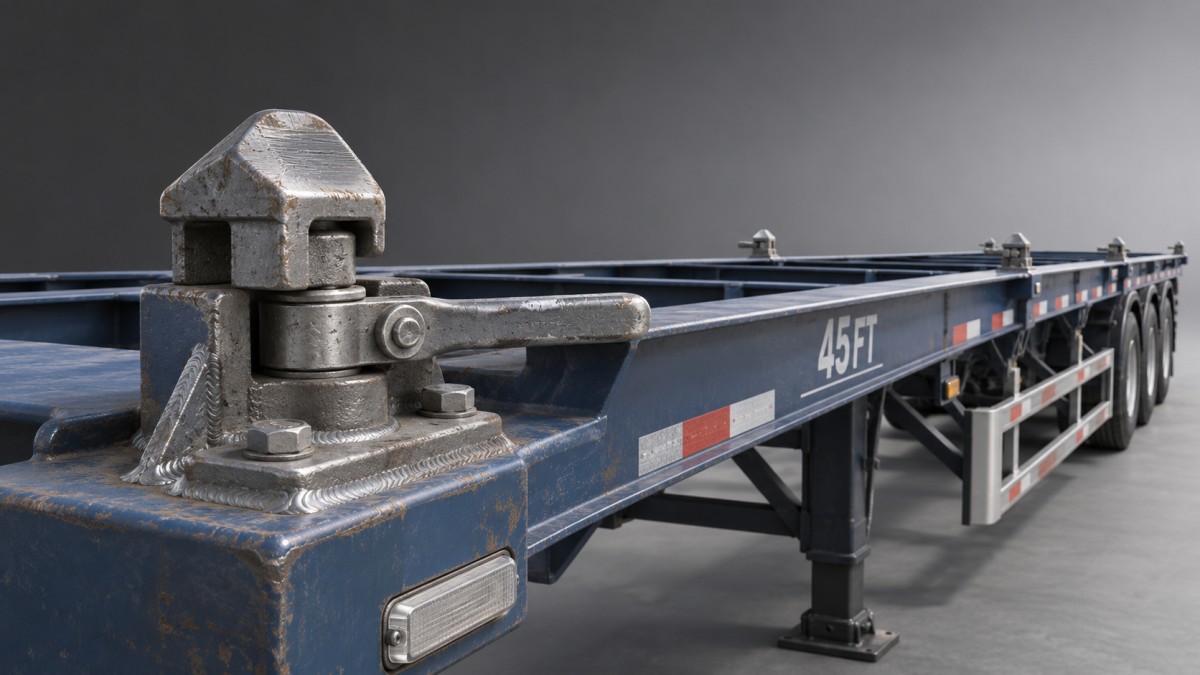
Read the wear marks on the head and mounting
The lock head bears against the inside of the container corner fitting when engaged. Inspect its contact faces and edges for flattening, grooves, gouges, uneven wear and missing material. A shiny patch can simply show contact; a deep groove or a visibly reduced section deserves closer assessment because the remaining material and engagement surface may be inadequate.
Look along the head and shaft for bends, twisting or a head that sits at an unusual angle. A distorted lock can be forced into a corner fitting but fail to reach its intended position. Check for cracks around the head, shaft, handle connection and mounting area. Pay particular attention to abrupt changes in section and damaged welds, where a crack may be partly hidden by paint or dirt.
Inspect the surrounding trailer structure as carefully as the lock itself. A sound-looking head cannot compensate for a loose housing, damaged retaining components, cracked weld or distorted mounting plate. Corrosion around the base may conceal loss of material, so clean the area sufficiently to establish its condition without removing sound metal.
Some damage is easier to see with the container off the trailer. If access is restricted, record the limitation and arrange a closer inspection rather than passing a component that cannot be assessed.
Check movement and locking action
With the lock unloaded and safe to operate, move the handle through its full intended travel. It should operate without abnormal binding and reach the specified locked and unlocked positions. Check that the handle’s retaining or latching device is present and works as designed. A handle that can work loose, will not stay secured, or stops short of its intended position is a defect requiring attention.
Check for abnormal movement at the head, shaft and mounting using the inspection method specified for the equipment. Some clearance may be inherent in the design, so movement alone is not a reliable pass-or-fail test. Investigate play that is noticeably greater than on comparable locks, has increased since the previous inspection, or prevents consistent engagement. Excessive movement can come from the lock assembly, its housing or the trailer mounting; replacing the head alone may not resolve it.
When a container is fitted, confirm that it is correctly seated and that each required lock has fully engaged its corner fitting. Follow the trailer and lock manufacturer’s procedure for confirming engagement: handle position, visual indicators and retaining arrangements vary by design. A handle that appears to be in place does not prove engagement if the container is misaligned or the mechanism has been forced.
Do not strike or force a stiff handle to make it close. Dirt, corrosion, a damaged mechanism or a container that is not properly seated can produce similar symptoms. The cause needs to be identified before the trailer returns to service.
Decide whether to monitor, measure or remove from service
For quality-control teams, the distinction between normal contact and unacceptable wear should rest on documented criteria. Where the manufacturer specifies dimensions, clearance limits or inspection methods, measure the suspect area with suitable tools and compare the result with those limits. Record the measurement and its location; a description such as “worn” makes later comparison difficult.
- Monitor: Light surface oxidation or polished contact areas may be acceptable if the lock operates correctly, the mounting is sound and inspection criteria are met. Record the condition and recheck it at the next scheduled inspection.
- Assess further: Grooving, localized corrosion, unusual play or stiffness warrants cleaning, measurement and examination of related parts. Keep the trailer out of service if secure engagement cannot be established.
- Remove from service: Cracks, deformation, missing or ineffective retainers, loose or damaged mountings, and failure to reach or maintain the locked position require corrective action before use.
If no wear limit is available, do not invent a clearance allowance or rely solely on a visual comparison. Obtain the correct inspection criteria from the trailer or lock manufacturer, or have a competent person assess the assembly. Any repair or replacement should follow the applicable manufacturer’s instructions, including requirements for compatible parts and work on the mounting.
Keep the inspection tied to the trailer’s actual work
Repeated container handling, misalignment during loading, road contamination and exposure to corrosive conditions can affect locks differently across a trailer. A lock that receives more contact damage than its neighbors may point to a loading or alignment issue as well as a worn component. Record recurring defects by lock position so that maintenance can investigate the pattern.
The same inspection principles apply to container-carrying flatbeds, although the lock layout and permitted container positions must be checked for each vehicle. For example, the 40ft 3-Axle Flatbed Trailer is described for carrying 20ft and 40ft standard containers and other cargo; its configuration should not be assumed to match the lock positions on a 45ft skeletal trailer.
Before release after corrective work, confirm that the affected lock operates and retains its position, the mounting is secure, and the required locks engage correctly with the intended container. Keep the inspection and repair record linked to the trailer and lock position so the next inspector can identify any change.
Related Posts
- ▶ How to Choose the Right Flatbed Semi Trailer for Your Fleet?
- ▶ Flatbed Semi Trailer: 5 Common Transportation Problems and Their Solutions
- ▶ Double Deck Car Carrier Trailer: Improve Vehicle Transport Efficiency and Reduce Costs
- ▶ What tie-down capacity does a 3 axle flatbed trailer need?
- ▶ How does axle spacing affect a 3 axle flatbed trailer's load limit?
- ▶ When is a 3 axle flatbed trailer better than a 2 axle model?
- ▶ How to distribute a concentrated load on a 3 axle flatbed trailer
- ▶ What determines the unladen weight of a 45ft skeletal trailer?
- ▶ How does a sliding axle affect 45ft skeletal trailer use?
- ▶ How to identify a worn twist lock on a 45ft skeletal trailer
CONTACT US

Established in 2006, CHINA SINOTRUCK(HK) LIMITED Trailer supplies different types of products and provides relevant technical support and services to foreign customers.
Get in Touch
*We respect your confidentiality and all information are protected.