
Since 2006
Welcome to CHINA SINOTRUCK(HK) LIMITED !










What turning clearance does a 45ft skeletal trailer need?
How much room does a 45ft skeletal trailer need to turn safely? For drivers and operators, the answer depends on more than trailer length.
Tractor wheelbase, axle configuration, steering angle and the path of the container all affect the space required. Off-tracking and rear swing matter at tight junctions.
This guide explains the key clearance factors and how to assess a turning route before moving through depot entrances, loading areas and other restricted spaces.
How much turning clearance should you allow?
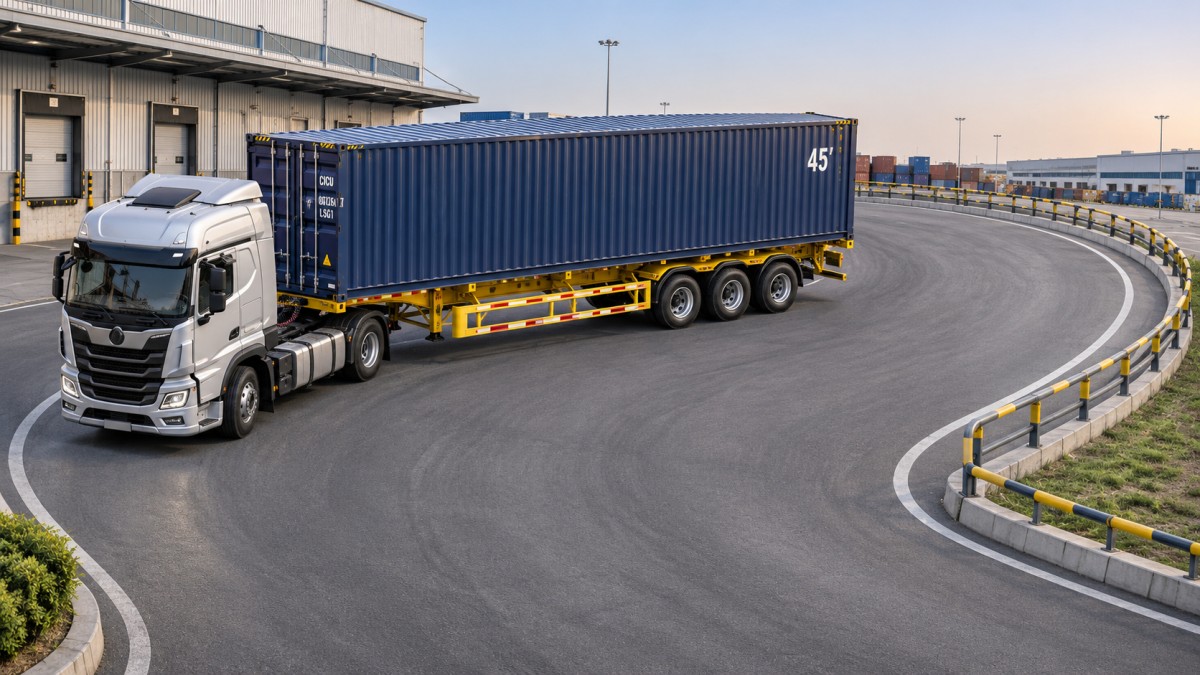
There is no single safe turning radius for every 45ft skeletal trailer. The complete tractor and trailer combination, the load and the intended manoeuvre determine the space needed.
For a new route or site, obtain a swept-path assessment for the actual vehicle combination. Until that assessment confirms otherwise, treat a tight turn as potentially unsuitable.
A measurement across the entrance alone is insufficient. Check the approach, the full corner and the exit, including space for the tractor’s front and the trailer’s rear.
If you have a manufacturer’s turning-circle figure, confirm exactly what it measures. A tractor figure, for example, does not describe the path of a coupled trailer.
What happens to the trailer during a turn?
In a forward turn, the trailer wheels generally follow a path inside the tractor’s wheels. This movement is called off-tracking, or cutting in.
The tighter the turn, the greater the chance that the trailer wheels will cross a kerb, enter another lane or strike an obstacle on the inside.
The rear of the trailer can also move outward as the vehicle begins to turn. Watch the rear corners, especially when pulling away beside parked equipment.
The container may add clearance risks above wheel height. Its corners can pass close to signs, walls or other vehicles even when the wheels appear clear.
In a right-hand turn, check the inside on the right and the outward movement on the left. Reverse those sides for a left-hand turn.
Actual movement depends on the vehicle geometry and steering input. Use both mirrors and observe the full combination throughout the manoeuvre, not only at the corner.
Which vehicle details change the space required?
Start with the distance from the kingpin to the trailer axle group. A longer distance generally increases off-tracking during a comparable low-speed turn.
Tractor wheelbase, steering lock and fifth-wheel position affect where the tractor can travel and how the trailer follows. Changing tractors can therefore change the result.
Axle configuration matters too. A fixed three-axle group may scrub its tyres on tight turns; a steering axle may track differently depending on its design.
Check whether any lift axle is raised or lowered as specified for the load and local rules. Its position can affect handling, tyre contact and turning behaviour.
Container size, position and any permitted projection affect the vehicle’s outer envelope. Include container corners and securing equipment when checking clearance near structures.
Finally, road camber, slopes and uneven ground can change clearances. A route that looks adequate on level pavement may bring the container closer to an overhead obstruction.
How can you check a tight turn before driving it?
Walk the route when it is safe to do so. Look from the approach through the exit, and identify anything the vehicle could strike or overrun.
Measure the usable width and relevant distances between fixed obstacles. Allow for kerbs, bollards, parked vehicles, gateposts, drainage edges and any equipment temporarily stored nearby.
Check overhead and side clearance as well as ground-level width. Include signs, canopies, cables, door frames and building projections along the entire path.
Confirm the container height and vehicle dimensions from reliable measurements or records. Compare them with posted restrictions, while recognising that signs may not describe every obstruction.
Ask the site operator for a swept-path drawing where available. It should match your tractor, trailer, axle setup, load dimensions and intended direction of travel.
A drawing based on a different vehicle is a guide, not proof of clearance. It also needs to reflect current site conditions and suitable safety margins.
Agree on the entry path and any traffic controls before starting. If the turn requires space from another lane, arrange safe control of that space first.
Use a trained spotter where visibility is limited or the site requires one. Agree on positions, signals and a stop signal before moving.
Keep the spotter in sight and stop immediately if visual contact is lost. The driver remains responsible for controlling the vehicle and following site procedures.
If the route cannot be verified, stop in a safe place and seek an alternative approach. Do not rely on speed or force to make the turn.
How should you make the turn?
Approach slowly, with enough space to position the tractor for the planned path. Avoid committing to the corner before confirming that the exit is clear.
Use the available road width only when it is lawful and safe. A wider approach may help, but it must not create an uncontrolled hazard for others.
During the turn, monitor the inside trailer wheels, the outside rear corner and the tractor’s front. Mirrors provide useful views but do not eliminate blind spots.
Make steering adjustments smoothly and avoid sharp corrections unless needed for safety. Stop if the trailer approaches an obstacle or the intended path becomes uncertain.
Watch for pedestrians and moving equipment throughout the manoeuvre. A clear path at the start can change while the vehicle is turning.
Once the rear has passed the restriction, continue checking until the entire combination is clear. Straighten only when there is enough room ahead and alongside.
What if the trailer does not appear to fit?
Stop before contact becomes likely. Reassess the available space with the site operator, including whether a different entrance, approach direction or delivery time is available.
Remove temporary obstructions only with the site operator’s agreement. Fixed structures, public traffic and ground conditions may still prevent the manoeuvre after the area is cleared.
Reversing to reposition introduces its own risks. Use the site’s reversing procedure, suitable guidance and a clear escape route, and avoid reversing into uncontrolled traffic.
Do not assume a trailer will fit because another 45ft unit has used the entrance. Different axle positions, tractors and container dimensions can change the swept path.
Repeated tyre scrub or a need to run over kerbs is a sign to reassess the route. Check for tyre or vehicle damage after any contact.
Does the same advice apply to other three-axle trailers?
The clearance principles apply to other articulated trailers, but their dimensions and bodies differ. Assess each vehicle using its own specifications and load envelope.
For example, the Heavy Duty 3-Axle Box Semi Trailer is an enclosed steel box trailer for packaged goods, food and bagged materials.
Its three 13-tonne axles and mechanical suspension describe its configuration, but they do not establish its turning clearance. Obtain the relevant dimensions before planning its route.
Plan the whole path, not just the corner
A 45ft skeletal trailer needs enough room for the tractor, trailer wheels, rear swing and container to clear obstacles from approach to exit.
Use vehicle-specific dimensions and a swept-path assessment to judge unfamiliar or restricted routes. On the day, inspect the area, move slowly and stop whenever clearance is uncertain.
Related Posts
- ▶ Double Deck Car Carrier Trailer: Improve Vehicle Transport Efficiency and Reduce Costs
- ▶ What turning clearance does a 45ft skeletal trailer need?
- ▶ How to check container overhang on a 45ft skeletal trailer
- ▶ Can a 45ft skeletal trailer carry a 40-foot container?
- ▶ Does a lighter flatbed container trailer increase usable payload?
- ▶ How to inspect a flatbed container trailer for frame cracks
- ▶ Is a flatbed container trailer suitable for non-container cargo?
- ▶ What causes uneven tire wear on a flatbed container trailer?
- ▶ When does a flatbed container trailer need a reinforced deck?
- ▶ How to check twist lock alignment on a flatbed container trailer
CONTACT US

Established in 2006, CHINA SINOTRUCK(HK) LIMITED Trailer supplies different types of products and provides relevant technical support and services to foreign customers.
Get in Touch
*We respect your confidentiality and all information are protected.