
Since 2006
Welcome to CHINA SINOTRUCK(HK) LIMITED !










How to check container overhang on a 45ft skeletal trailer
To check container overhang on a 45ft skeletal trailer, measure how far the container projects beyond the relevant trailer reference points, then compare those measurements with the applicable route rules and the trailer manufacturer’s approved loading arrangement. A container can sit securely on its locks and still create an excessive rear projection, an unsuitable axle load or a combination that exceeds an overall length limit.
For quality control and safety managers, the inspection should produce more than a single number. Record where the container sits, which reference points were used, whether every required twist lock is engaged, and whether the loaded combination can travel legally on its intended route.
Start with the loading arrangement and reference points
Park the trailer on firm, level ground, apply the parking brakes and use the site’s normal controls for working around vehicles. The container should be fully seated in its intended position before measurements are taken. If the trailer has an extendable frame or adjustable locking positions, establish which configuration is in use and whether the manufacturer approves it for that container.
Check the container identification and size against the trailer’s rated loading arrangements. The term “45ft” alone does not establish that every 45ft container can be carried in every lock position. A trailer may have several sets of locks, and the correct set depends on its design and the container configuration. Use the trailer documentation or an approved loading diagram to identify the intended supports and locking points.
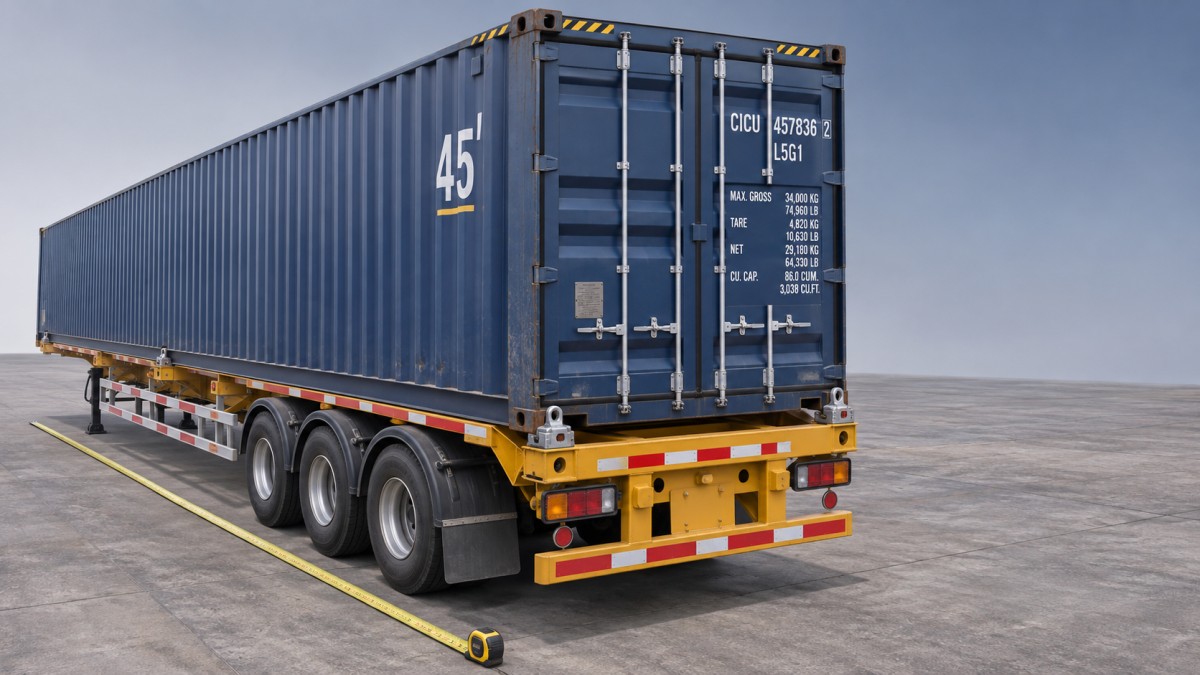
Agree on the measurement reference before recording overhang. For a physical inspection, useful measurements include the horizontal distance from the rear end of the trailer structure to the rearmost part of the container, and any projection beyond the front of the trailer structure. For legal assessment, the applicable rules may define overhang from an axle, axle group, coupling point or another prescribed datum. A measurement from the frame end cannot automatically be substituted for a legally defined measurement.
Record the container’s foremost and rearmost projections, including fittings or cargo that extend beyond its main structure where the applicable rules require them to be included. Also measure the overall length of the coupled vehicle combination when the route rules place a limit on it.
Measure the projection consistently
Use a tape measure, straightedge and, where useful, a plumb line or laser to transfer the container and trailer reference points to the ground. Take horizontal measurements parallel to the vehicle’s longitudinal axis. Measuring diagonally from a visible corner can overstate the distance and make later comparisons unreliable.
A practical sequence is:
- Mark the rearmost point of the trailer reference structure and the rearmost point of the container on the ground. Measure the distance between the marks along the vehicle’s length.
- Repeat at the front if the container projects beyond the trailer reference structure, and record the distance and direction of the projection.
- Measure from the legally prescribed datum separately, if that datum differs from the frame end. Identify the datum in the inspection record.
- Measure the coupled combination’s overall length and any other dimensions required for the intended route.
Take care with rear structures such as underrun protection, lighting brackets and bumpers. They may extend beyond the main chassis rails, but their presence does not necessarily determine the reference point used by a particular regulation. State exactly what was measured rather than writing only “rear overhang.”
Where the container is offset or its geometry is irregular, check both sides and use the furthest relevant projection. If the result is close to a legal or operational limit, repeat the measurement with suitable equipment and leave enough allowance for measurement uncertainty and movement in service. Do not release the vehicle on the assumption that a borderline reading will be accepted.
Inspect the locks, supports and clearance
Walk around the trailer and inspect every required container corner and twist lock. The container should sit on the intended support surfaces, with the locks properly engaged and secured in accordance with the trailer manufacturer’s instructions. Check visible lock indicators where fitted, but do not rely on an indicator alone if the lock or its surrounding structure appears damaged or obstructed.
Look for bent support plates, cracked welds, damaged corner castings, debris trapped between contact surfaces and signs that the container is sitting unevenly. A gap at one support may indicate incorrect positioning, deformation or an obstruction. Do not compensate by leaving a lock partially engaged or by placing an unapproved spacer under the container.
Front projection deserves a separate clearance check. With the tractor coupled, assess the space between the container, the tractor cab and any equipment behind the cab. Consider the movement allowed by the coupling during turning and changes in road gradient. A container may appear clear when the combination is straight but foul the cab or equipment during a manoeuvre. Follow the vehicle manufacturer’s clearance requirements and site procedures; do not put personnel in a pinch point to observe a turn.
At the rear, check whether the container or its doors interfere with lights, registration plates, conspicuity markings or required protective equipment. Any warning signs, lamps or markings for a projecting load must match the rules for the route and the conditions of travel.
Check weight distribution as well as dimensions
Overhang changes where container weight acts in relation to the tractor and trailer axles. Two containers with the same external dimensions can produce different axle loads if their cargo is distributed differently. A legal projection and correctly engaged locks therefore do not establish that the combination is within its weight limits.
Obtain a reliable loaded container mass and check it against the permitted capacities of the trailer, coupling equipment, tractor and complete combination. Where axle loads cannot be established confidently from an approved calculation, use a suitable weighbridge or axle weighing facility. Compare the results with the applicable axle, axle-group and gross combination limits for the intended route.
If an axle is overloaded, investigate the cargo distribution and approved container positions before moving the load. Shifting a container to another set of locks may change axle loading, clearance and overhang at the same time. Any repositioning must remain within the trailer manufacturer’s approved arrangement and be followed by another inspection and, where necessary, reweighing.
Use the rules for the actual route
There is no single overhang figure that can be applied safely to every jurisdiction and vehicle configuration. Check the rules for each road jurisdiction on the journey, including restrictions on overall length, axle loads, rear projection and required warnings. Permit conditions or restrictions on particular roads may also affect whether a movement can proceed.
Separate three questions in the inspection record: Is the container positioned within the trailer’s approved loading arrangement? Are the vehicle and axle loads within their applicable limits? Do the measured dimensions and any required markings satisfy the route rules? Each question needs its own evidence; a pass on one does not establish a pass on the others.
The same discipline applies across a mixed fleet: use inspection criteria specific to the vehicle and load. For example, an 38000L Aluminum Alloy Straight-Beam Split-Type Fuel Tanker Trailer carries fuel in a tank rather than a container on twist locks, so its load security and distribution checks follow a different configuration.
Before release, keep the measured values, reference points, trailer configuration, lock inspection result, weight evidence and applicable route requirements together in the inspection record. If a measurement, lock condition or clearance falls outside the approved criteria, hold the vehicle until the cause has been corrected and the affected checks have been repeated.
Related Posts
- ▶ Double Deck Car Carrier Trailer: Improve Vehicle Transport Efficiency and Reduce Costs
- ▶ What turning clearance does a 45ft skeletal trailer need?
- ▶ How to check container overhang on a 45ft skeletal trailer
- ▶ Can a 45ft skeletal trailer carry a 40-foot container?
- ▶ Does a lighter flatbed container trailer increase usable payload?
- ▶ How to inspect a flatbed container trailer for frame cracks
- ▶ Is a flatbed container trailer suitable for non-container cargo?
- ▶ What causes uneven tire wear on a flatbed container trailer?
- ▶ When does a flatbed container trailer need a reinforced deck?
- ▶ How to check twist lock alignment on a flatbed container trailer
CONTACT US

Established in 2006, CHINA SINOTRUCK(HK) LIMITED Trailer supplies different types of products and provides relevant technical support and services to foreign customers.
Get in Touch
*We respect your confidentiality and all information are protected.