
Since 2006
Welcome to CHINA SINOTRUCK(HK) LIMITED !










What tie-down capacity does a 3 axle flatbed trailer need?
A 3 Axle Flatbed Trailer does not have a fixed tie-down capacity requirement simply because it has three axles. The required restraint depends on the weight and behavior of the cargo, the direction in which it could move, the securement method, and the rules that apply along the route. Axle ratings describe part of the trailer’s load-carrying capability; they do not establish the strength of its anchor points or the capacity of its straps and chains.
For a practical starting point, U.S. federal cargo securement rules generally require the aggregate working load limit of the tie-downs used to secure an article or group of articles to be at least one-half of its weight. That is a minimum aggregate capacity calculation, subject to specific counting rules and other requirements. It does not, by itself, prove that the load is secure. Different jurisdictions can use different design forces and calculation methods, so safety managers should apply the rules for the whole journey before approving a restraint plan.
Start with the load, then calculate credited tie-down capacity
The working load limit, or WLL, is the maximum load a component is rated to carry in service under specified conditions. It is different from breaking strength. For a flatbed, the relevant components include straps or chains, hooks, tensioners, connecting hardware and the trailer’s attachment points. A high-rated strap cannot make an inadequately rated anchor point stronger.
Under the general U.S. calculation in 49 CFR 393.106, the contribution of a tie-down depends on how it is attached. In simplified terms:
- A tie-down running from an anchor point on the vehicle, over or through the cargo, to another anchor point on the same side of the vehicle contributes one-half of its WLL.
- A tie-down attached to the vehicle at both ends and passing over, through or around the cargo, with its ends on opposite sides of the vehicle, contributes its full WLL.
- A tie-down with one end attached to the vehicle and the other attached to the article contributes one-half of its WLL.
These are aggregate WLL accounting rules, not a calculation of the actual force each restraint can resist in every direction. The regulation also addresses tie-downs that pass through anchor points and are attached to the vehicle, as well as the effect of different WLLs in a tie-down assembly. Use the complete regulatory wording for an arrangement that does not fit the examples above.
Consider a 20,000 lb article secured under the general U.S. rules with four identical tie-downs, each rated at 3,000 lb WLL, passing over the article and attached to opposite sides of the trailer. Their aggregate credited WLL is 12,000 lb, exceeding the 10,000 lb minimum based on half the article’s weight. That arithmetic is only the first check: the anchor points and connections must be suitable, the number and placement of tie-downs must meet applicable rules, and the load must be restrained against movement in the required directions.
In particular, U.S. rules can require a minimum number of tie-downs based on an article’s length and weight, with different provisions where forward movement is blocked or where an article has additional securement requirements. A capacity calculation that passes the half-weight test can still fail those provisions.
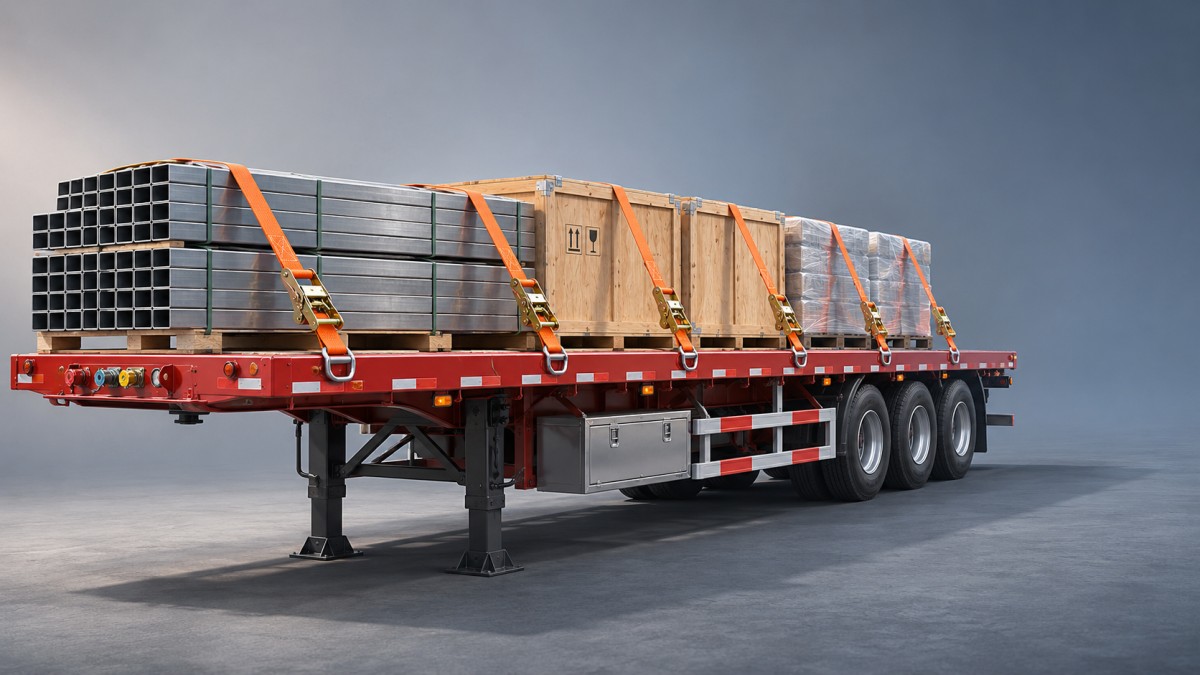
Why the same weight can need a different arrangement
A low, stable bundle resting evenly on the deck behaves differently from a tall machine with a small footprint. The machine may be more prone to tipping, while a bundle can shift internally if individual pieces are free to slide. Cargo shape, center of gravity, contact area, packaging and load distribution all affect the restraint plan.
The direction of restraint matters as well. Braking loads can push cargo forward; cornering can move it sideways; road movement can contribute to upward or rearward displacement. The U.S. general performance criteria in 49 CFR 393.102 address forces in each direction. Passing the aggregate WLL calculation alone does not demonstrate compliance with those performance criteria.
Over-the-top restraints rely in part on downward force and friction between the cargo and deck. Direct restraints, by contrast, connect the cargo to the vehicle to resist movement. Their effectiveness depends on attachment geometry, including angles and the direction of the anticipated force. Avoid assuming that a strap’s full rated capacity acts horizontally or that friction has a particular value without a sound basis.
Blocking, bracing and friction-enhancing materials can form part of a securement system where permitted, but they must be suitable for the cargo and capable of transferring forces into the vehicle structure. A headboard, stake pocket or side rail should not automatically be treated as a rated restraint point. Its intended function and load rating need to be established for the proposed use.
Some cargoes have specific rules in addition to general requirements. In the United States, examples include logs, metal coils, concrete pipe and heavy vehicles or equipment. Their provisions can affect the restraint method, minimum number of tie-downs or other details. Outside the United States, identify the applicable national and transit-country rules; European operations, for example, may use EN 12195-1 calculations within the relevant regulatory framework. Do not combine a percentage from one regime with assumptions from another and treat the result as an approved plan.
Check the trailer’s attachment points as carefully as the straps
Before specifying restraint capacity for a flatbed, obtain the manufacturer’s information for the actual trailer and anchor configuration. Look for the location and rated capacity of each load-securing point, any restrictions on loading direction, and instructions on how loads may be distributed between points. A drawing is useful when several tie-downs will share one attachment area: the plan should show which point each restraint uses and whether the structure can accept the combined loading.
Where an anchor rating is absent, a strap label does not fill the gap. The owner or manufacturer should establish an appropriate rating or provide an engineered restraint arrangement before the point is relied on. Also check that hooks fit the attachment points properly and remain engaged when the tie-down is tensioned.
The distinction matters when comparing three-axle trailers for different cargo. An enclosed 3-Axle Box Van Semi Trailer with Side Door, for example, is intended for goods including palletized cargo and consumer products. Its three 13T axles describe axle configuration; they do not establish the restraint rating of its floor, walls or internal attachment points. Those ratings must be assessed for the chosen load and securement method, just as anchor ratings must be assessed on a flatbed.
What quality and safety teams should inspect
A restraint plan is only useful if the equipment on the trailer matches it. Before dispatch, compare the cargo weight and arrangement with the approved plan, then inspect the load and every component that contributes to securement. Pay particular attention to:
- Identification: WLL markings on straps, chains and hardware should be legible. Apply the relevant rules for unmarked or unidentified equipment; do not assign a convenient rating by appearance.
- Condition: Remove damaged or worn equipment from service under the applicable criteria. Cuts, abrasion, damaged stitching, distorted hooks, cracked fittings and damaged tensioners can make an assembly unsuitable.
- Contact points: Protect webbing where it contacts edges that could cut or abrade it, and ensure protection does not prevent proper tensioning.
- Load stability: Check that pallets, bundles and packaging can withstand the restraint forces and that loose pieces are separately secured where necessary.
- Anchor condition: Look for deformation, cracks, corrosion or repairs that could affect an attachment point or the surrounding structure.
Securement can change after departure as cargo settles or restraints lose tension. Establish inspection and adjustment procedures that meet the rules for the route and account for the load’s characteristics. U.S. rules, for example, include inspection and adjustment requirements at specified stages of a journey, with certain exceptions.
For acceptance or dispatch, the decision should rest on a documented match between the load, the applicable rules and the actual restraint system: each component’s rating and condition, the credited capacity of the arrangement, the minimum number and placement of restraints, and the ability to control movement in every required direction. If any of those elements cannot be established, the calculation alone is not enough to release the load.
Related Posts
- ▶ How to Choose the Right Flatbed Semi Trailer for Your Fleet?
- ▶ Flatbed Semi Trailer: 5 Common Transportation Problems and Their Solutions
- ▶ Double Deck Car Carrier Trailer: Improve Vehicle Transport Efficiency and Reduce Costs
- ▶ What tie-down capacity does a 3 axle flatbed trailer need?
- ▶ How does axle spacing affect a 3 axle flatbed trailer's load limit?
- ▶ When is a 3 axle flatbed trailer better than a 2 axle model?
- ▶ How to distribute a concentrated load on a 3 axle flatbed trailer
- ▶ What determines the unladen weight of a 45ft skeletal trailer?
- ▶ How does a sliding axle affect 45ft skeletal trailer use?
- ▶ How to identify a worn twist lock on a 45ft skeletal trailer
CONTACT US

Established in 2006, CHINA SINOTRUCK(HK) LIMITED Trailer supplies different types of products and provides relevant technical support and services to foreign customers.
Get in Touch
*We respect your confidentiality and all information are protected.