
Since 2006
Welcome to CHINA SINOTRUCK(HK) LIMITED !










How does axle spacing affect a 3 axle flatbed trailer's load limit?
How does axle spacing affect a 3 axle flatbed trailer's load limit?
Axle spacing affects how much weight a 3 Axle Flatbed Trailer can legally and safely carry, but it does not determine payload on its own. The distance between axles influences how a load is distributed over the road and how regulators classify an axle group. Suspension capacity, tire ratings, frame strength, tractor limits and cargo position can all impose lower limits.
The distinction matters when comparing specifications. A trailer may have enough rated axle capacity for a proposed load yet still be unsuitable for a route because of an axle-group limit, bridge restriction or excessive load on the tractor’s drive axles.
What spacing changes—and what it does not
Axle spacing is normally measured center to center. For a three-axle group, evaluators should request both adjacent spacings and the distance between the first and third axle centers. The outer distance describes the group’s spread; the individual distances help identify its geometry and how it may be classified under local rules.
A wider spread can distribute the group’s load over a longer section of pavement or bridge. Depending on the jurisdiction, that may allow a higher legal group weight. It does not automatically increase the rated capacity of the axles, suspension, tires or chassis, and it may not produce a legal increase if another limit is already controlling.
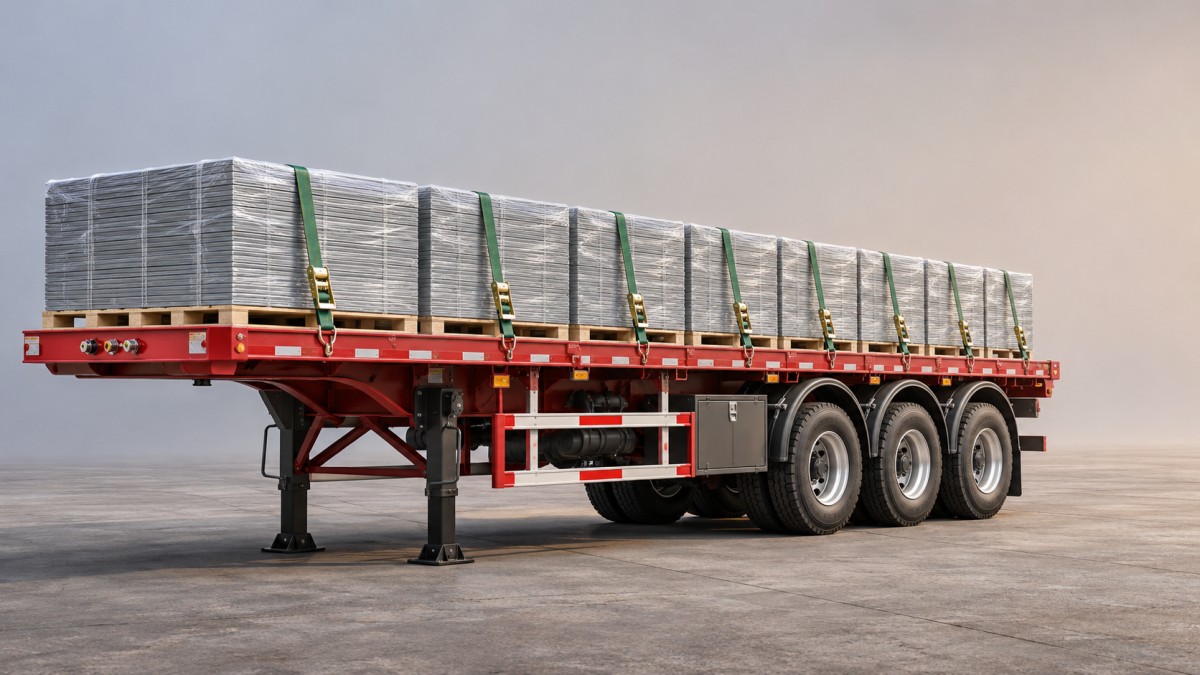
Spacing also has operating consequences. A longer axle group can increase tire scrub during tight turns and place additional lateral demands on tires, suspension components and the pavement. For equipment working repeatedly in ports or congested yards, a small theoretical weight advantage needs to be considered alongside maneuverability and maintenance.
Legal group weight is route-specific
Regulations do not treat every three-axle arrangement in the same way. Some jurisdictions define group limits by axle count and spacing; others apply bridge or road protection rules to particular sets of consecutive axles. A change in spacing can therefore change the applicable classification rather than simply add a fixed amount to the permitted load.
In the United States, the federal bridge formula relates allowable weight on a group of consecutive axles to the number of axles and the distance between the outermost axles of that group. It is one check within a broader set of federal and state requirements, including axle and gross-weight limits. The U.S. Federal Highway Administration publishes guidance on the formula; evaluators should also check the rules and permits applicable to the actual route.
Do not apply that formula automatically to a trailer destined for another market. For routes in Africa, Southeast Asia, the Middle East or South America, obtain the current requirements from the relevant road authority and verify any corridor, border or bridge restrictions. A manufacturer’s nominal payload is not a substitute for that check.
The cargo position may be the deciding factor
A semi-trailer transfers part of its loaded weight through the kingpin to the tractor and the remainder to its axle group. Moving the cargo center of gravity forward generally increases the kingpin reaction; moving it rearward generally increases the trailer axle-group reaction. The actual distribution depends on the trailer geometry, empty weight distribution and coupling position.
That makes a single payload figure a poor basis for evaluating concentrated cargo. A steel coil, machine or short container can overload a local section of the frame or one support area even when the total combination weight is within a legal limit. Check the manufacturer’s load diagram, permitted load concentration and required cargo supports, not just the deck length.
An initial static calculation can estimate the kingpin and axle-group reactions using the loaded center of gravity and the distance between the kingpin and the effective axle-group support point. Treat it as a screening tool: suspension behavior, road slope, loading tolerances and individual axle differences mean that it cannot replace weighing the actual combination.
Why adding axle ratings can be misleading
Three rated axles do not necessarily carry equal loads in service. Equalization depends on suspension design and condition, tire sizes and pressures, ride height, frame alignment and road surface. Leaf spring systems, for example, should be assessed with their equalizer arrangement and specified installation geometry rather than assumed to share weight perfectly.
Tire capacity must be checked at the specified inflation pressure and operating configuration. The applicable wheel, hub, brake and suspension ratings matter too. The lowest relevant component rating, the manufacturer’s approved vehicle rating and the legal limits all constrain the usable load. None can be overridden by a favorable axle-spacing calculation.
The frame deserves a separate review. Main-beam plate thicknesses provide useful identification, but they do not establish payload by themselves: beam depth, material, welds, crossmembers, support locations and load distribution also affect structural performance. Ask for an approved loading diagram or engineering assessment for heavy concentrated loads.
Compare complete configurations, not just axle counts
Combination layouts make this particularly important. The 20ft + 40ft Superlink Flatbed Semi Trailer is described as a 20 ft front and 40 ft rear arrangement for carrying both container sizes simultaneously. Its listed specification includes leaf spring suspension, four FUWA 13-ton axle sections and a dual air brake system with a WABCO valve.
That is a different combination from a conventional three-axle flatbed. The listed axle ratings should not be added together and treated as its legal cargo capacity. Its coupling arrangement, axle positions, empty weights, container loading and route rules must be assessed as a complete vehicle combination. In particular, confirm the axle arrangement and dimensions on the relevant drawing before comparing it with a single semi-trailer.
CHINA SINOTRUCK(HK) LIMITED Trailer, established in 2006, supplies semi-trailers and other transport equipment to overseas markets and provides technical support. For an evaluation, the useful next step is to request the drawing and ratings for the exact configuration rather than rely on a general product description.
A practical verification sequence
Start with the intended tractor, cargo and route. Obtain the trailer’s axle center measurements, kingpin location, unladen weight and unladen axle reactions, together with the approved axle, suspension, tire and chassis ratings. Confirm whether the dimensions and weights refer to the supplied equipment, including optional components.
Then check the proposed load position against both structural guidance and the legal limits for every relevant axle group. Include the tractor’s steering and drive axles, the combination gross weight and any route-specific restrictions. For container work, verify the permitted load positions and twist-lock arrangement rather than assuming every container can be placed anywhere on the deck.
Before regular operation, weigh the loaded combination by axle or axle group on a suitable scale. If the result is close to a limit, allow for practical variations in cargo placement and equipment weight. Axle spacing is an essential input, but the defensible load limit is the lowest applicable limit for the actual vehicle, cargo and route.
Related Posts
- ▶ How to Choose the Right Flatbed Semi Trailer for Your Fleet?
- ▶ Flatbed Semi Trailer: 5 Common Transportation Problems and Their Solutions
- ▶ Double Deck Car Carrier Trailer: Improve Vehicle Transport Efficiency and Reduce Costs
- ▶ What tie-down capacity does a 3 axle flatbed trailer need?
- ▶ How does axle spacing affect a 3 axle flatbed trailer's load limit?
- ▶ When is a 3 axle flatbed trailer better than a 2 axle model?
- ▶ How to distribute a concentrated load on a 3 axle flatbed trailer
- ▶ What determines the unladen weight of a 45ft skeletal trailer?
- ▶ How does a sliding axle affect 45ft skeletal trailer use?
- ▶ How to identify a worn twist lock on a 45ft skeletal trailer
CONTACT US

Established in 2006, CHINA SINOTRUCK(HK) LIMITED Trailer supplies different types of products and provides relevant technical support and services to foreign customers.
Get in Touch
*We respect your confidentiality and all information are protected.