
Since 2006
Welcome to CHINA SINOTRUCK(HK) LIMITED !










When is a 3 axle flatbed trailer better than a 2 axle model?
A 3 Axle Flatbed Trailer is often the better choice when a two-axle combination cannot carry the required load within the applicable axle and vehicle weight limits, or when the load needs to be distributed across a larger axle group. The extra axle also adds weight and operating costs, and it can make tight turns harder. The decision should therefore start with the intended cargo and routes, then move to a loaded-weight calculation for the complete tractor-trailer combination.
Start with legal payload, not the advertised trailer capacity
A trailer’s rated capacity describes a limit set by its design and components. It does not, by itself, tell you how much cargo the combination can legally carry on a particular route. Permitted gross weight, axle-group limits, axle spacing, tire ratings and tractor capacity can all restrict the usable payload.
The load is shared between the tractor and the trailer axle group through the fifth wheel and kingpin connection. Adding a trailer axle can increase the load the rear group is allowed to carry where regulations and vehicle design permit it. It does not automatically increase the permissible gross weight by the rating of that axle, and it cannot compensate for an overloaded tractor drive axle.
Compare the two configurations with the same tractor, equipment and intended cargo. Begin with the unladen weight of each complete combination, including fuel, securing equipment and any accessories normally carried. Then calculate the loaded weight on the tractor axle groups and trailer axle group for the proposed cargo position. The useful payload is limited by whichever applicable weight or component limit is reached first.
For example, if a two-axle trailer reaches its permitted trailer-axle load before the vehicle reaches its gross weight limit, a suitable three-axle design may allow more cargo to be carried legally. If the gross combination limit is already the constraint, the heavier three-axle trailer may instead leave less capacity for cargo.
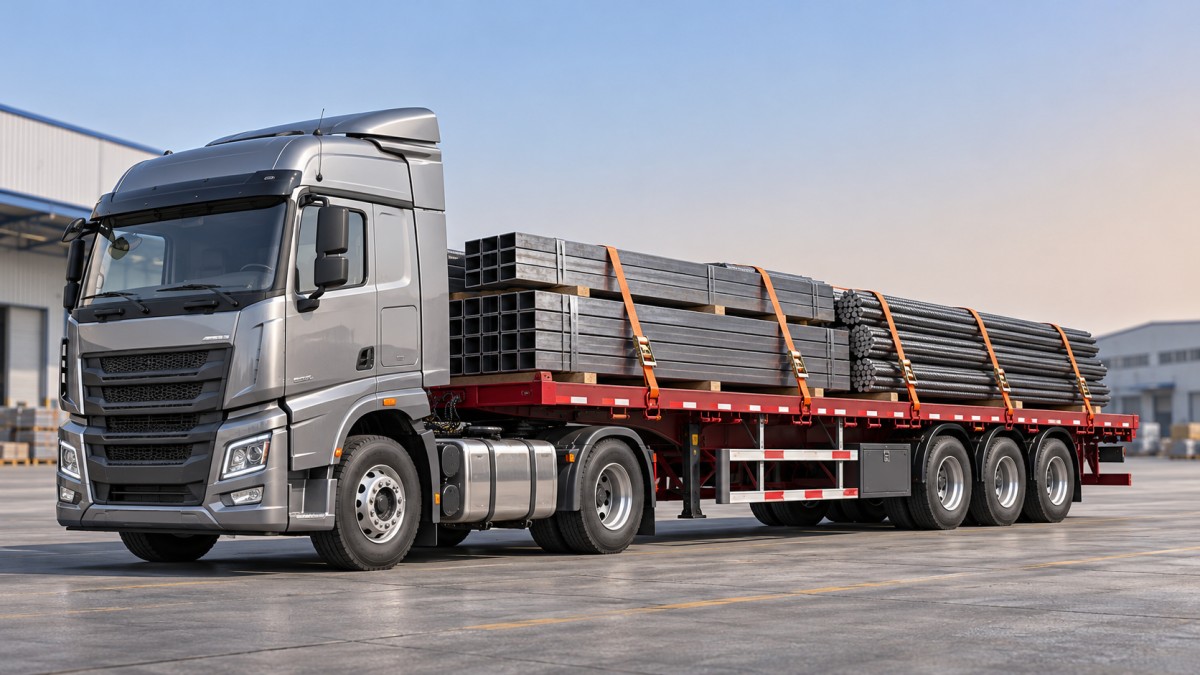
When does the third axle provide a practical advantage?
Heavy loads are a regular part of the work. Steel products, machinery and construction materials can bring axle limits into play well before the deck is full. A third axle may make a heavier load practical when the chassis, suspension, tires, tractor and route limits support it. The case is strongest when those heavier trips occur often enough to justify carrying the extra axle on lighter or empty journeys.
The route limits the load on an axle group. Roads and bridges may be subject to restrictions based on axle loads, axle spacing or overall vehicle weight. A three-axle group can distribute load over more wheel positions, but the benefit depends on how the route’s rules treat that particular axle arrangement. A trailer that works on the main highway may still face a restriction on an access road or bridge near the loading site.
Traction and loading positions need to be balanced. Cargo placed too far rearward can overload the trailer axle group; cargo placed too far forward can overload the tractor’s drive axles or exceed the fifth-wheel rating. An additional trailer axle may provide more room within the rear group’s limits, allowing a workable cargo position. The tractor still needs sufficient drive-axle load for traction, and its axle ratings remain binding.
The operating environment is demanding. On rough routes, a well-specified three-axle trailer may be useful for distributing a heavy load across more tires and suspension points. That does not make axle count a substitute for a suitable chassis, suspension travel, tire selection or operating speed. Road shocks can impose high dynamic loads on any configuration, especially when the cargo is concentrated in a small area.
When a two-axle flatbed may be the better purchase
A two-axle trailer often makes more sense when normal loads fit comfortably within its legal and technical limits. Its lower unladen weight can preserve payload, particularly where the overall combination weight is the limiting factor. It also typically has fewer tires, wheel ends, brakes and suspension components to maintain.
Maneuvering is another consideration. A three-axle group generally scrubs its tires more during tight turns, which can increase tire wear and resistance. The swept path also depends on wheelbase, axle spacing, steering arrangements and tractor geometry, so assess the complete combination against the turns it must make. Reversing into confined yards or negotiating narrow site entrances may favor the shorter or more maneuverable specification.
Empty running matters as well. The extra axle adds mass on every trip, including trips that do not use its load-carrying potential. Fuel consumption can also rise because of additional weight and rolling resistance, although the difference depends on the trailer specification, route, load and driving conditions.
Check the load itself, not just its total weight
Two cargoes with the same weight can place very different demands on a flatbed. A long, evenly supported load spreads weight along the deck; a compact machine may put much of its weight through a few small contact points. The deck, crossmembers and main beams must be suitable for those local loads as well as the overall payload.
Ask for the manufacturer’s loading guidance for the proposed cargo: permitted load positions, support areas and any limits on concentrated loads. For machinery, include the position of its center of gravity and the weight carried at each support point. For long material, consider the location of supports, overhang and how the load will be restrained. Neither axle count nor a high axle rating establishes that the deck can carry any load placed on it.
Load distribution should be checked for partial loads and multi-drop work too. Removing cargo from one end of the deck changes the forces on the tractor and trailer axles. A load plan that is compliant at departure may need adjustment after a delivery.
Compare complete specifications and operating costs
For a meaningful quotation, give suppliers the same duty description: cargo types and dimensions, expected loaded and empty journeys, tractor configuration, loading methods, routes and site constraints. Request a loaded axle-weight calculation and a drawing showing the proposed axle spacing, kingpin position and usable deck dimensions for each option.
Review the components as a system. Axle, tire, wheel, brake, suspension and coupling ratings must suit the intended loads. Check whether the tractor’s fifth-wheel position and coupling are compatible with the trailer, and whether brake connections and electrical systems match. Availability of replacement parts and service support along the operating route can influence downtime as much as the initial specification.
Then compare the purchase price with the costs that change over the intended service life: tires, brakes, wheel-end maintenance, fuel and any additional trips needed when payload is restricted. If the three-axle option can carry more legal cargo per trip, include the value of those avoided trips. If both options carry the same working load, the lighter configuration may be more economical.
Keep body type separate from axle count
A flatbed is useful when cargo needs open access for crane or side loading, or when its shape suits an open deck. If the actual requirement is to protect packaged goods, food or bagged materials inside an enclosed body, compare box trailers as a separate option. For example, the Heavy Duty 3-Axle Box Semi Trailer has an enclosed steel body, three 13-tonne axles and mechanical suspension. Those features describe a different body configuration; they do not establish the capacity or suitability of a flatbed.
Choose the axle arrangement after defining the body and loading method. The strongest case for three axles is a recurring, properly supported load that a comparable two-axle combination cannot carry within its applicable limits. Where both configurations meet the duty, use maneuverability, unladen weight and lifetime operating costs to decide.
Related Posts
- ▶ How to Choose the Right Flatbed Semi Trailer for Your Fleet?
- ▶ Flatbed Semi Trailer: 5 Common Transportation Problems and Their Solutions
- ▶ Double Deck Car Carrier Trailer: Improve Vehicle Transport Efficiency and Reduce Costs
- ▶ What tie-down capacity does a 3 axle flatbed trailer need?
- ▶ How does axle spacing affect a 3 axle flatbed trailer's load limit?
- ▶ When is a 3 axle flatbed trailer better than a 2 axle model?
- ▶ How to distribute a concentrated load on a 3 axle flatbed trailer
- ▶ What determines the unladen weight of a 45ft skeletal trailer?
- ▶ How does a sliding axle affect 45ft skeletal trailer use?
- ▶ How to identify a worn twist lock on a 45ft skeletal trailer
CONTACT US

Established in 2006, CHINA SINOTRUCK(HK) LIMITED Trailer supplies different types of products and provides relevant technical support and services to foreign customers.
Get in Touch
*We respect your confidentiality and all information are protected.