
Since 2006
Welcome to CHINA SINOTRUCK(HK) LIMITED !










Can a 4-axle fence semi trailer carry loose bulk cargo?
Can a 4-Axle Fence Semi Trailer carry loose bulk cargo safely and efficiently? The answer depends on the cargo, the trailer’s construction and the regulations on the intended route. A fence trailer may be suitable for some loose materials when its floor and sides provide adequate containment and its structure is approved for the load. Four axles alone, however, do not make it a bulk trailer.
For a technical evaluation team, the question is not simply whether the material fits inside the body. It is whether the complete combination can carry, contain and discharge that material repeatedly without exceeding structural or legal limits.
Start with the material, not the trailer’s advertised capacity
Loose bulk cargo covers materials with very different handling characteristics. Coarse aggregate, grain, wood chips and fine powders do not exert the same pressure on the body or escape through the same gaps. Before requesting a quotation, define the material’s bulk density, particle size, moisture range and likely loading method.
Coarse, relatively dry materials may be manageable in a suitably reinforced and lined fence body, provided the floor, gates and sides are rated for the duty. Even then, impacts from a loader bucket and abrasion from sharp material can damage a body intended mainly for palletized goods.
Grain and other free-flowing agricultural products require close attention to leakage, moisture protection and cleaning. A continuous liner or solid side panels may help, but their joints and door seals need to withstand pressure from the load. Where food or feed hygiene applies, confirm that contact surfaces and cleaning arrangements meet the buyer’s requirements.
Fine powders, very wet materials or hazardous cargo generally call for a purpose-designed body. A tarpaulin over an open fence structure is not equivalent to a sealed bulk tank, and a basic liner should not be assumed to provide dust-tight or liquid-tight containment.
What must change on a fence trailer?
A conventional fence body can have gaps around the floor, side posts, tailgate and lower rails. For loose cargo, those openings become both a product-loss issue and a road-safety concern. Ask the supplier to explain the complete containment arrangement rather than merely offering “extra panels.”
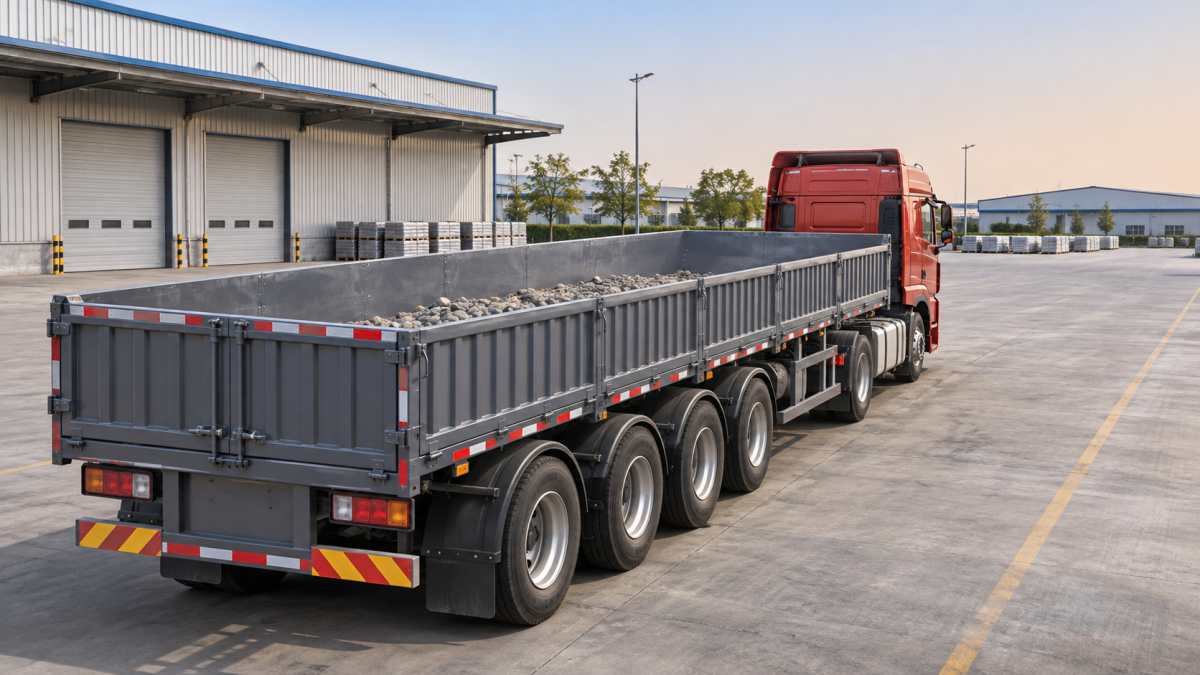
- Floor and joints: Check the floor material, thickness, supports and resistance to abrasion. Inspect seams and connections for likely leakage points.
- Side and front walls: Verify that panels, posts and attachments are designed for the lateral pressure of the specified material and loading height. A fence that restrains packages may not safely retain a dense bulk load.
- Tailgate: Confirm its load rating, locking arrangement and sealing details. Consider how residual material will be controlled when the gate is opened.
- Cover: Specify a properly secured cover when needed to prevent spillage, dust or rain ingress. Its suitability depends on the material and route requirements.
- Liner: Check how it is fixed, whether it can withstand abrasion, and how it will be inspected, cleaned and replaced.
Containment modifications add weight and may change the forces acting on the trailer. The manufacturer should review them as part of the complete design, not as an afterthought performed without structural assessment.
Four axles do not determine the legal payload
A four-axle layout can offer additional axle capacity compared with some lower-axle-count arrangements, but the permitted payload depends on more than axle count. The trailer’s rated gross weight, chassis, suspension, tires, wheels, coupling and tractor all matter. So do axle-spacing rules, bridge restrictions and the legal limits in every country or region on the route.
A practical starting point is:
Allowable payload = applicable permitted gross combination weight − actual unloaded weight of the tractor, trailer, equipment and operating supplies.
That calculation is only a starting point. Individual axle and axle-group limits must also be satisfied, and the payload must not exceed the manufacturer’s ratings. Use actual tare weights for the proposed configuration, including liners, panels, covers and any loading accessories.
Check volume and axle distribution together
Compare the cargo’s bulk density with the usable body volume. A material may reach the weight limit while the body still looks partly empty; a lighter commodity may fill the body before reaching the allowable payload. Moisture can also change the weight of a load, so base planning on the expected operating condition rather than an ideal dry sample.
Load position matters as much as total weight. A mound concentrated near the front can overload the tractor’s drive axles or exceed the permitted kingpin load. Too much weight toward the rear can overload the trailer axle group and reduce traction or steering stability. Request a load-distribution calculation for the intended tractor, coupling position and cargo pattern, then verify the loaded combination on a certified weighbridge before routine operation.
Can the cargo be unloaded where it is delivered?
This question can change the procurement decision. A fence semi trailer is not automatically a tipper. If the body has no approved tipping mechanism or discharge equipment, the operator may need a loader, excavator, conveyor or manual assistance to remove the material. Each option affects turnaround time, site access and the risk of damaging the floor.
Also examine the discharge sequence. Opening a loaded tailgate can release material unexpectedly; workers should not stand in the potential discharge path. The receiving site needs a defined procedure for securing the vehicle, controlling the gate and clearing residual cargo. For frequent bulk deliveries, compare the total handling process with a purpose-built dump trailer or bulk grain transport vehicle, not just the purchase specification.
Equipment transport is a different application. For buyers who also move excavators or rollers, the 3-Axle Low Bed Trailer for Sale is intended for heavy machinery rather than loose bulk cargo. Its low deck and gooseneck arrangement address equipment loading and stability; they do not provide the enclosed body needed for bulk containment.
Questions to put in the technical inquiry
A useful supplier response should connect the proposed design to a defined duty. Include the commodity, density range, maximum moisture, loading equipment, discharge method, route and expected trip frequency. Then ask for documentation covering:
- The trailer’s rated gross weight, verified tare weight and proposed payload for the specified configuration.
- Axle, suspension, tire and coupling ratings, together with an axle-load assessment for the intended tractor.
- Floor, sidewall, front-wall and tailgate construction, including the approved loading height for the material.
- Sealing, liner and cover details, plus inspection and maintenance requirements.
- Applicable certification and road-compliance documentation for the actual trailer and destination market.
Established in 2006, CHINA SINOTRUCK(HK) LIMITED Trailer supplies several vehicle types and technical support to overseas customers. Its range includes ordinary semitrailers and bulk grain transport vehicles, making a comparison between body types a relevant part of the inquiry. Certification and configuration should nevertheless be checked against the specific product offered, rather than assumed from a company-wide list.
The procurement decision
Choose a 4-Axle Fence Semi Trailer for loose bulk cargo only when the supplier can substantiate the complete configuration for the material, loading method and route. A sealed and reinforced body may suit a mixed-use operation carrying compatible commodities, but frequent bulk work, difficult discharge or strict containment requirements may justify a purpose-built vehicle.
The best specification is the one that remains workable after the first load: legal on the road, secure at the tailgate, manageable at the receiving site and straightforward to inspect between trips.
Related Posts
- ▶ How to Choose the Right Flatbed Semi Trailer for Your Fleet?
- ▶ Flatbed Semi Trailer: 5 Common Transportation Problems and Their Solutions
- ▶ Double Deck Car Carrier Trailer: Improve Vehicle Transport Efficiency and Reduce Costs
- ▶ Can a 4-axle fence semi trailer carry loose bulk cargo?
- ▶ What cargo is suited to a 4-axle fence semi trailer?
- ▶ How do tire replacement costs affect a 3 axle flatbed trailer?
- ▶ What tie-down capacity does a 3 axle flatbed trailer need?
- ▶ How does axle spacing affect a 3 axle flatbed trailer's load limit?
- ▶ When is a 3 axle flatbed trailer better than a 2 axle model?
- ▶ How to distribute a concentrated load on a 3 axle flatbed trailer
CONTACT US

Established in 2006, CHINA SINOTRUCK(HK) LIMITED Trailer supplies different types of products and provides relevant technical support and services to foreign customers.
Get in Touch
*We respect your confidentiality and all information are protected.