
Since 2006
Welcome to CHINA SINOTRUCK(HK) LIMITED !










How do tire replacement costs affect a 3 axle flatbed trailer?
Tire replacement costs affect a 3 axle flatbed trailer well beyond the price of a new tire. A lower-priced tire can cost more over the trailer’s working life if it wears out sooner, is unavailable along the operating route, or requires unplanned roadside replacement. The trailer’s axle alignment, load distribution, suspension condition and tire pressures can be just as important as the tire brand.
The useful comparison is therefore cost per distance traveled, adjusted for downtime and maintenance. For a trailer with dual wheels on each of its three axles, even a modest difference in the service life of each tire can materially change the operating budget.
Calculate the cost of a tire position, not just a tire
A three-axle trailer with dual wheels has 12 running tires, excluding any spare. The complete replacement bill includes the tires themselves, fitting, valves or other service parts where required, disposal charges and the cost of taking the vehicle out of service. Emergency callouts and roadside fitting should be considered separately because they can cost substantially more than planned workshop work.
A practical comparison starts with:
Tire cost per kilometer = total tire-related expenditure over the period ÷ distance traveled in that period.
Include the purchase and fitting of replacement tires, repairs, casings or retreading where applicable, and tire-related callout costs. Deduct any verified casing credit or salvage value. Exclude fuel or maintenance savings unless there is a consistent way to measure them; otherwise, the comparison can give a false impression of precision.
For example, suppose a 12-tire set costs $4,800 fitted and delivers 120,000 km. Its illustrative tire cost is $0.040 per kilometer. A $6,000 set delivering 180,000 km costs approximately $0.033 per kilometer. The second option has a higher initial outlay but a lower cost per kilometer under those assumptions. These figures are examples, not market quotations or expected tire life.
Real fleets rarely replace all 12 tires at the same mileage. Individual tire records provide a better basis for comparison: record the position, installation date, odometer or hubometer reading, tread condition, removal reason and final cost. A tire removed early because of a puncture should not automatically be treated as evidence that its design wears faster.
Load capacity and fitment set the minimum specification
The cheapest suitable tire is not necessarily the tire with the lowest advertised price. It must be approved for the axle load, speed, wheel fitment and service conditions. Check the tire’s load index and manufacturer’s load-and-inflation information for dual fitment; the permitted load per tire in a dual assembly can differ from its single-tire rating. The rated capacity also depends on the specified inflation pressure.
Axle-group weight alone does not show whether every tire is adequately loaded. Cargo position, uneven pavement, cornering and differences between dual tires can place more load on particular wheel positions. A flatbed carrying concentrated machinery loads presents a different load-distribution problem from one carrying evenly distributed freight. Axle and, where practical, individual wheel-end measurements give a stronger basis for selection than dividing gross weight evenly across all tires.
Rim size, approved rim width, tire clearance and the required spacing between dual tires also matter. An unsuitable combination can create contact between sidewalls or interfere with suspension and bodywork as the tires deflect. Any proposed change in tire size should be checked against the tire and wheel manufacturers’ specifications as well as local vehicle requirements.
For comparison, the 40ft 3-Axle Skeleton Semi-Trailer is specified with 12 × 12R22.5 tires and 9.00-22.5 rims. It is a container chassis rather than a flatbed, so its configuration is useful as an illustration of tire-count and fitment checks, not as proof that the same tires are suitable for a flatbed’s loads. The listed axle and tire ratings still need to be checked against the actual operating configuration.
Uneven wear can make the trailer more expensive than the tires suggest
If several tires wear unevenly or require replacement long before their expected tread life, replacing them with another brand may not resolve the cause. A three-axle group has several components that affect how tires track and share load, including axle alignment, suspension links, springs, bushings and wheel-end condition.
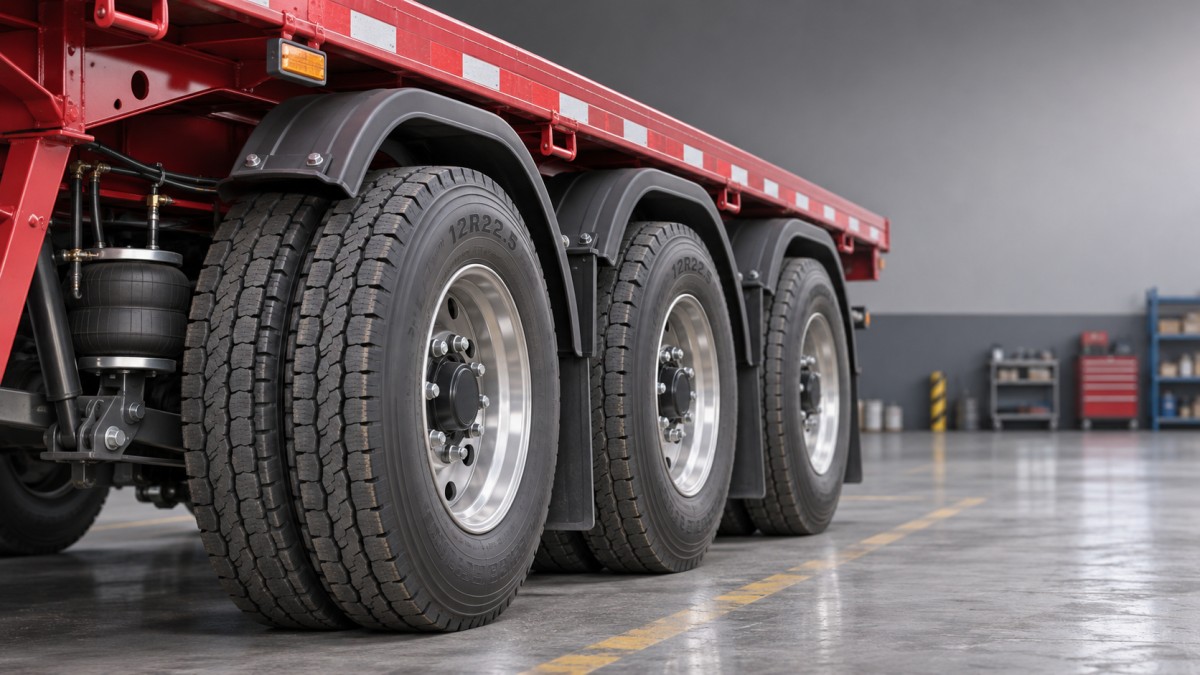
Shoulder wear, feathering, cupping or localized flat spots are useful diagnostic clues, but no single pattern proves a fault. For example, pressure problems, alignment errors, bearing issues and braking faults can produce overlapping symptoms. Compare tires across positions, check inflation when cold, inspect the suspension and wheel ends, and measure alignment against the trailer manufacturer’s specifications before attributing the problem to the tire.
Scrub is another cost consideration. During tight turns, the tires on a multi-axle trailer cannot all follow the same path without some lateral slip. Frequent maneuvering in confined yards can therefore produce a different wear pattern from long, relatively straight highway operation. A tire selected only for highway mileage may not give the lowest cost in a route with repeated tight turns and abrasive surfaces.
Dual-wheel matching also affects service life. Differences in tire size or effective rolling circumference can cause one tire to carry more than its share of the load. Follow the tire manufacturer’s matching limits for diameter, tread depth and pressure rather than assuming two tires marked with the same nominal size will perform identically.
Replacement timing changes both cost and availability
Replacing tires in a planned workshop visit reduces the risk of paying for recovery or interrupting a loaded trip. It also allows related work—such as inspecting valve stems, rims, brakes and wheel bearings—to be coordinated with an existing maintenance stop. That does not mean replacing every tire prematurely: removing serviceable tread has a cost too.
A replacement threshold should account for legal tread-depth requirements on the routes used, tire condition, expected distance to the next service and the operator’s inspection capability. Cuts, exposed cord, bulges, abnormal wear or other damage can make a tire unsuitable regardless of remaining tread depth. Repair and continued service should follow the tire manufacturer’s and applicable regulatory requirements.
Retreading can reduce expenditure where the tire casing is suitable and qualified retreading capacity is available. Its value depends on casing inspection, the intended service, local rules and the price of a comparable new tire. A low retread price is not a saving if damaged casings are rejected or if collection and downtime costs erase the difference.
Use the tire plan when comparing trailer quotations
Two similarly priced flatbeds can have different lifecycle costs if one uses a tire size that is difficult to source on the intended route, has limited clearance for approved alternatives, or arrives with insufficient information about alignment and suspension settings. Ask suppliers to identify the fitted tire size, load and speed ratings, rim specification, axle ratings and recommended cold pressures for the intended loads. Confirm whether the quoted price includes a spare and whether replacement tires are locally available.
When comparing configurations, use the same annual distance, load profile, routes and accounting period. Add the expected fitted tire expenditure, inspection and alignment costs, and a separately stated allowance for tire-related downtime. Test the result against shorter tire life or a higher replacement price rather than relying on one optimistic estimate.
The most economical choice is the configuration that meets load and fitment requirements while delivering predictable wear and service access. A tire budget based only on purchase price cannot show whether the trailer will achieve that result.
Related Posts
- ▶ How to Choose the Right Flatbed Semi Trailer for Your Fleet?
- ▶ Flatbed Semi Trailer: 5 Common Transportation Problems and Their Solutions
- ▶ Double Deck Car Carrier Trailer: Improve Vehicle Transport Efficiency and Reduce Costs
- ▶ How do tire replacement costs affect a 3 axle flatbed trailer?
- ▶ What tie-down capacity does a 3 axle flatbed trailer need?
- ▶ How does axle spacing affect a 3 axle flatbed trailer's load limit?
- ▶ When is a 3 axle flatbed trailer better than a 2 axle model?
- ▶ How to distribute a concentrated load on a 3 axle flatbed trailer
- ▶ What determines the unladen weight of a 45ft skeletal trailer?
- ▶ How does a sliding axle affect 45ft skeletal trailer use?
CONTACT US

Established in 2006, CHINA SINOTRUCK(HK) LIMITED Trailer supplies different types of products and provides relevant technical support and services to foreign customers.
Get in Touch
*We respect your confidentiality and all information are protected.