
Since 2006
Welcome to Shandong Shanglong Trading Co., Ltd !










Lowbed Semi-Trailers Stacked Shipping Method | Why We Stack Lowbed Trailers for Sea Export
Intro
For international trailer exporters focusing on Africa, Southeast Asia & Middle East markets, ocean freight cost has always been one of the biggest expense items. Lowbed semi-trailers (low platform trailers for construction machinery transport) are long, large-volume cargo. If shipped one by one, container space utilization is extremely low, leading to exorbitant sea charges.
Therefore, stacked nesting loadinghas become the most mainstream, cost-saving delivery solution for bulk lowbed trailer export orders. Today we will break down the whole process, applicable models, operation standards & advantages.
1. What is Stacked Shipping for Lowbed Trailers?
Stacked loading means putting 2–3 identical lowbed semi-trailers nested and overlapped together securely before stuffing into 40HQ / flat rack containers or bulk carriers.
By utilizing the hollow gooseneck structure and concave flatbed design of lowbed trailers, the upper trailer can sink into the frame gap of the bottom trailer, greatly compressing overall occupied length, height and volume.
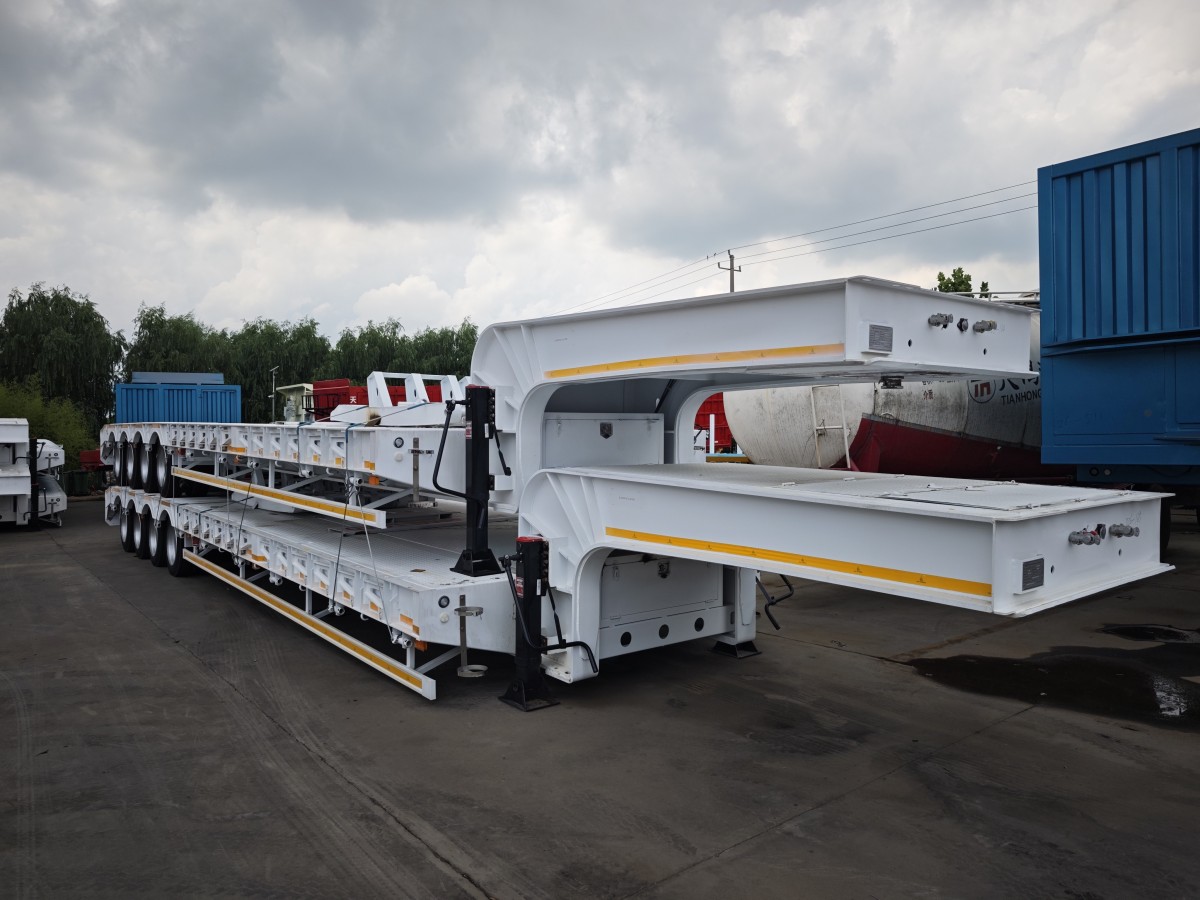
From your picture:
This is double stacked lowbed semi-trailers, the front gooseneck section of the rear trailer is inserted under the main beam of the front one, perfectly nested without extrusion deformation.
2. Which Types of Lowbed Trailers Are Suitable for Stacked Delivery?
✅ Applicable Models
Fixed gooseneck lowbed semi-trailer (most common for African market, 3-axle / 4-axle standard 13m/14m excavator transport trailer)
Mechanical spring ramp lowbed trailer (with rear loading ladders, ladders can be folded inward to save space for stacking)
Straight beam standard lowbed with concave cargo platform
❌ Not Recommended to Stack
Detachable gooseneck (RGN) heavy-duty lowbed: complicated split structure, poor nesting compatibility
Extra-wide / customized super low flatbed with special outrigger accessories
Hydraulic multi-axis modular heavy haul trailers
3. Standard Stacking Operation Steps (Factory Working Flow)
Step 1: Pre-inspection & Accessory Disassembly
Fold rear spring loading ladders inward and lock tightly;
Remove loose small parts: mudguards, side guardrails, spare tire brackets, lamp holders, all fittings packed into iron boxes fixed on the trailer beam;
Deflate tires appropriately (not fully flat) to lower overall height for easier nesting;
Check all suspension, landing legs, brake pipelines to avoid friction damage during stacking.
Step 2: Precise Nesting Alignment
Place the first trailer steadily on flat ground as the base carrier; lower its landing legs fully to keep the whole frame horizontal & stress balanced;
Use a truck tractor to slowly back the second trailer, aim its gooseneck hollow cavity to sink onto the main longitudinal beam of the bottom trailer;
Adjust position left-right & front-back to ensure the frames do not collide, stress evenly distributed on the whole beam.
Step 3: Fastening & Reinforcement (Core Safety Step)
Use high-tensile steel wire ropes + turnbuckles to cross tie the upper and lower trailers at multiple points (front gooseneck, middle side lashing rings, rear tail part);
Place thick rubber anti-slip gaskets between contact positions of two frames to prevent paint scratching and sliding during sea turbulence;
Lock landing legs of the upper trailer to avoid shaking up and down; brake system kept locked.
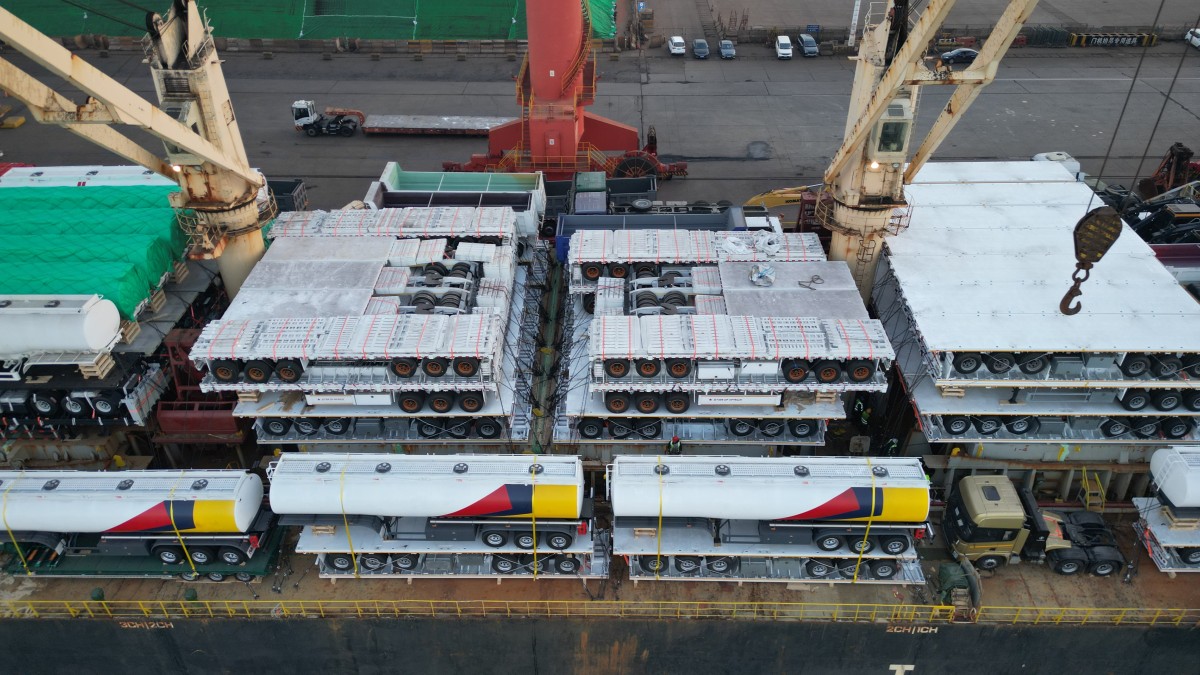
Step 4: Container Loading / Bulk Vessel Stowage
For 40HQ Flat Rack container: 2 units stacked lowbeds can be loaded per flat rack;
For bulk ship breakbulk cargo: 2~3 units nested together hoisted on board, fixed to vessel deck lashing points.

4. Core Benefits of Stacked Lowbed Trailer Shipment
1. Cut Ocean Freight Cost Dramatically
Original: 1 trailer needs one flat rack container
After stacking: 2 trailers share one flat rack → 50% sea freight saved directly, the biggest advantage for bulk orders.
2. Improve Container Space Utilization
Lowbeds are slender long cargo, single loading wastes lots of vertical & horizontal space; nesting makes overall volume shrink by nearly 40%.
3. Stable Structure, Safe for Long Ocean Voyage
Qualified factory stacking follows mechanical stress design, frames bear load evenly, with multi-point lashing fixing. No slipping, deformation or brake pipeline damage during long-distance sea transportation.
4. Higher Order Delivery Efficiency
Less container booking quantity needed, shorter waiting time for empty containers, faster whole logistics cycle for clients.
5. Key Notes to Avoid Shipping Damage
Never stack trailers with different lengths / different beam structures; uneven stress will bend the main frame;
Do not over-stack: maximum 3 units for light-duty lowbeds, 2 units is the safest standard for heavy-load African-spec lowbeds;
All hydraulic parts, valve blocks must be wrapped with waterproof plastic film to resist sea salt fog corrosion;
Mark stacking direction & lifting points clearly for overseas clients to unstack smoothly after arrival at destination port.
Closing Words
Stacked nested shipment is a mature, cost-effective logistics solution tailored for lowbed semi-trailer export business. We always prioritize both freight cost control and product transportation safety, helping our overseas partners get construction machinery transport trailers with lower overall procurement cost.
If you need customized lowbed trailers & optimized stacking shipping plan for your local market, welcome to consult us anytime.
Related Posts
CONTACT US

Established in 2006, Shandong Shanglong Trading Co., Ltd Trailer supplies different types of products and provides relevant technical support and services to foreign customers.
Get in Touch
*We respect your confidentiality and all information are protected.